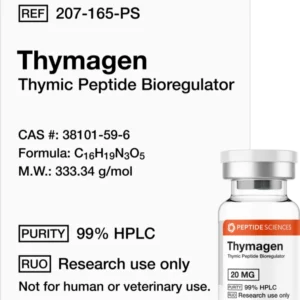
Thymogen 20mg for Laboratory Research
Thymogen is the name associated in scientific literature with the dipeptide L-glutamyl-L-tryptophan, commonly abbreviated L-Glu-L-Trp. Peptide Lab Sciences lists this research material as Thymagen (Thymogen) 20mg within its peptide bioregulator catalogue.
This page explains the terminology used in the listing, introduces relevant published research and outlines the information laboratories should review before purchasing. Its purpose is to help researchers distinguish the named compound from similarly named materials and assess the available product information.
A product title is the starting point for selection. The current specification, supporting documentation and requirements of the intended experiment should guide the purchasing decision.
Browse our peptide bioregulators category to explore related listings. Review each material individually, because membership of the same category does not establish equivalent composition or experimental behaviour.
This product is presented for laboratory research only. It is not offered for personal administration, consumption or use in humans or animals.
Thymogen Product Overview
The following table separates the catalogue information from details that require a current specification or relevant documentation.
| Detail | Information |
|---|---|
| Catalogue name | Thymagen (Thymogen) 20mg |
| Literature name | Thymogen |
| Dipeptide discussed in the literature | L-glutamyl-L-tryptophan |
| Sequence abbreviation | L-Glu-L-Trp |
| Stated product quantity | 20mg |
| Catalogue category | Peptide Bioregulators |
| Physical presentation | Confirm from the current specification |
| Composition and chemical form | Request details where required |
| Identity and purity | Review available documentation for the supplied material |
| Intended use | Laboratory research only |
The table does not establish a production method, purity percentage, counterion, shelf life or biological activity value.
Before selecting Thymogen, identify the information your laboratory needs and check whether the available specification answers those questions. Where an essential detail is missing, obtain clarification before ordering.
What Is Thymogen?
The scientific literature describes Thymogen in connection with a defined dipeptide containing glutamic acid and tryptophan residues. The notation L-Glu-L-Trp identifies the sequence discussed in those publications.
Historical research distinguishes this defined dipeptide from the broader thymic peptide preparation known as Thymalin. A publication describing natural and synthetic thymic peptides explains the relationship between these materials and identifies the synthesised dipeptide associated with the Thymogen name.
Read the publication on natural and synthetic thymic peptides for that historical background.
This background should not be interpreted as proof of how an individual commercial batch was manufactured. The origin of a research idea and the production history of a supplied material are separate questions.
For product selection, match the specification to the compound required by your project rather than relying on historical associations alone.
Why the Names Thymagen and Thymogen Appear Together
The catalogue uses “Thymagen (Thymogen)” as its product name. Scientific references linked on this page use Thymogen or the chemical description L-Glu-L-Trp.
When preparing a purchase order, retain the full catalogue name so the supplier can identify the correct listing. In your literature notes, preserve the terminology used by the authors.
Keeping both records allows colleagues to trace the connection between the ordered product and the scientific background you reviewed.
Do not assume that every similar-looking name on another website identifies the same preparation. Check the stated sequence and supporting specification when comparing materials.
This is particularly useful when an inventory system shortens product names. An abbreviated label should remain linked to a record containing the complete identifier.
Thymogen and Other Thymic Peptide Materials
A shared naming theme does not establish chemical equivalence. Researchers should distinguish a defined dipeptide from a peptide mixture, a longer peptide or a differently specified preparation.
The historical publication linked above discusses Thymalin and the dipeptide associated with Thymogen as distinct materials. That distinction should remain visible when reviewing studies and choosing a product.
Avoid transferring results from a broadly described thymic preparation to a defined compound without examining what the investigators actually used.
Similarly, a catalogue category such as “Peptide Bioregulators” provides a browsing structure. It does not replace the individual product specification.
When comparing Thymogen with another listing, begin with the full material identifier and available composition information. If those details differ or remain unclear, document the uncertainty before treating the products as comparable.
Understanding the L-Glu-L-Trp Notation
Sequence notation helps researchers identify the material discussed in a paper. In this case, Glu denotes glutamic acid and Trp denotes tryptophan, with the sequence written in the order used to describe the dipeptide.
Preserve the complete notation when requesting clarification about a product. A broad phrase such as “thymic peptide” provides less information than the sequence associated with the intended research material.
For Thymogen, ask whether the current specification identifies the chemical form sufficiently for your experiment. Your laboratory may require additional details that are not captured by a short sequence abbreviation.
Do not fill those gaps using information from an unrelated listing. Record what is stated, identify what is missing and request clarification where it affects the project.
What Does the 20mg Quantity Mean?
The 20mg declaration describes the stated product amount associated with this listing. It does not specify a working concentration, an experimental procedure or a suitable amount for administration.
The quantity alone also does not establish purity or functional activity.
Before purchasing Thymogen, determine whether your laboratory needs clarification about the basis of the mass declaration. For example, the purchasing specification may require information about the named material and any additional components in the preparation.
Keep the quantity declaration linked to the specification reviewed at the time of ordering. If written clarification is provided, retain it with the purchasing record.
This helps the receiving laboratory understand exactly what information was used to select the material.
Seven Essential Checks Before Ordering Thymogen
Use these checks to organise the purchasing review. They identify questions to resolve rather than promising that every document or test is available.
1. Match the material name.
Confirm that the project requires the compound identified in the listing and supporting specification.
2. Review the sequence information.
Check whether the available description matches the material discussed in the relevant research.
3. Confirm the quantity basis.
Determine whether the stated 20mg provides sufficient information for your procurement requirements.
4. Establish the supplied presentation.
Request the physical format if it is not clearly documented.
5. Examine available analytical evidence.
Identify the tests included and the material or batch to which they apply.
6. Obtain handling information.
Ensure that the laboratory can receive and manage the preparation using applicable instructions.
7. Retain the decision record.
Keep the reviewed specification, order reference and any clarification together.
Completing these checks before selecting Thymogen makes the purchasing decision easier for colleagues to review.
Published Research: Choosing Relevant References
A useful literature review begins with the material and question examined by the investigators. The references below provide different examples of research involving L-Glu-L-Trp or derivatives of that structure.
One primary study investigated L-glutamyl-L-tryptophan in experimental work involving natural killer cell activity and tumour models. Its relevance here is as a defined research example, not as evidence of a treatment benefit from this catalogue product.
Read the original study involving L-glutamyl-L-tryptophan and natural killer cells for the experimental context.
A separate investigation designed and synthesised derivatives of L-Glu-L-Trp using lipid and carbohydrate-related modifications. It examined modified structures rather than establishing that every property of those derivatives applies to the parent dipeptide.
The study of conjugated L-Glu-L-Trp derivatives provides a starting point for examining that distinction.
These papers are research references. They do not validate the supplied batch of Thymogen.
Separating Parent Compounds from Modified Derivatives
A paper may mention a familiar compound while focusing on a modified version of it. That distinction is important when collecting references for a project.
Check whether the authors used the parent dipeptide, a conjugate or another derivative. Retain the exact identifier in your literature notes.
Do not assume that a modification is merely a different spelling or presentation of the same material. The research question may specifically concern the consequences of changing the structure.
When evaluating Thymogen, use papers about derivatives as contextual evidence where appropriate. They should not substitute for identifying the actual compound your laboratory intends to investigate.
A short comparison table in your internal notes can help distinguish the material used in each paper from the product specification under review.
Reading Experimental Findings Carefully
Record the model, material, measurement and limitations before interpreting a study’s conclusion.
A useful review asks whether the investigators examined isolated cells, an animal model or another experimental system. It also identifies the endpoint that was measured and the comparison used.
Keep these details attached to any summary of the findings. A broad statement about “immune support” would lose the specificity needed for a research purchasing decision.
For Thymogen, focus on the evidence relevant to the intended laboratory question. Avoid collecting unrelated outcomes simply because they mention the same compound.
Where the publication does not provide a material detail that matters to your project, note the limitation instead of assuming a match.
Product Identity and Analytical Information
Scientific background and product qualification answer different questions. A paper can explain why a molecule is studied, while a relevant analytical report can provide information about a particular sample.
Before selecting Thymogen, identify which properties your laboratory needs documented.
Review the method, sample reference and reported result in any available document. A general statement such as “tested” does not tell you which property was assessed.
If a numerical result is provided, preserve its units and context. Avoid copying a value into an inventory record without the information required to understand it later.
Visit our quality control information page as part of your review. Contact us if your laboratory requires a detail that is not available in the listing.
Reviewing Batch Documentation
Where batch-specific documentation is available, confirm that its reference corresponds to the material being supplied.
Check the product identifier, report date and tests included. Distinguish measured results from specification limits or general product descriptions.
A report for another batch may provide background, but it does not automatically establish the properties of the preparation being purchased.
For Thymogen, discuss essential documentation requirements before ordering. This allows the laboratory to determine whether the available information meets its acceptance criteria.
If a required property remains undocumented, record the gap through your institution’s purchasing process. Do not replace missing evidence with assumptions based on the appearance of the product or its packaging.
Comparing Thymogen Research Listings
Use consistent comparison fields when reviewing different listings. Start with the named compound, sequence information, quantity basis and available specification.
Then compare the documentation relevant to your project. Mark unknown information clearly so that missing details do not appear equivalent to confirmed specifications.
Price can be considered alongside these factors, but it does not independently demonstrate identity or analytical quality.
Avoid relying on promotional adjectives when the purchasing decision requires evidence about a particular property.
Browse our research peptides catalogue to explore other materials. Each listing should be assessed against its own specification and the requirements of the intended work.
Preparing an Order for Your Laboratory
Before placing an order, agree on the essential requirements with the people responsible for procurement, receiving and experimental work.
Use the complete product name, Thymagen (Thymogen) 20mg, on the purchase record. Include any internal reference needed to connect the order to the project.
Confirm the receiving address and review the delivery options and terms presented during ordering.
If additional information is required, use the Peptide Lab Sciences contact page. Identify the product and ask for the specific document or clarification needed.
A precise enquiry helps separate questions about the catalogue listing from broader questions about published research.
Receiving and Recording the Material
On receipt, compare the label and accompanying information with the purchasing record. Record the date, product identifier and any batch reference provided.
Document discrepancies in the named material, quantity declaration or supplied information using your laboratory’s receiving procedure.
When assigning an internal sample code, keep it linked to the original order and specification. This allows another researcher to trace the material without relying on informal shorthand.
If an essential detail remains unclear, obtain clarification before proceeding with experimental work.
Retain the resolution with the inventory record so that colleagues can see how the issue was addressed.
Storage and Handling Information
Follow instructions applicable to the supplied preparation and your laboratory’s established procedures.
This page does not specify a universal storage temperature, solvent, shelf life or preparation method for Thymogen. Those details should come from information relevant to the actual material.
If the documentation distinguishes unopened material from material prepared for laboratory work, preserve that distinction in your records.
Avoid importing instructions from a different product because it has a similar name. Where necessary, request clarification before ordering so the receiving team can plan appropriately.
Record any departure from the applicable procedure that may need to be considered during review of the experiment.
Frequently Asked Questions
1. What is Thymogen?
Scientific literature associates the name with the dipeptide L-Glu-L-Trp. This catalogue lists the material as Thymagen (Thymogen) 20mg. Review the current specification to assess the supplied preparation.
2. Why does the product title also say Thymagen?
That is the catalogue naming used for this listing. Preserve the full product name in purchasing records and use the chemical identifier when checking the connection to published research.
3. Is Thymogen the same as Thymalin?
They should not be treated as interchangeable names. The historical literature distinguishes the defined dipeptide from the broader thymic peptide preparation called Thymalin. Check the exact material required by your project.
4. What does L-Glu-L-Trp identify?
It is the sequence notation used for the dipeptide discussed here. Retain the complete notation when requesting specifications or comparing the material described in different publications.
5. Does 20mg describe a dosage?
No. It describes the stated product quantity. It is not an instruction for administration, a working concentration or a biological activity measurement.
6. Is the physical format confirmed by the title?
No. Request the current specification if the supplied presentation is not clearly documented. A name and mass declaration do not establish every preparation detail.
7. Is a certificate of analysis available?
Check the documentation available for the material being supplied. Contact Peptide Lab Sciences if your institution requires a particular report before purchasing.
8. Do the references prove the quality of this product?
No. The publications provide research context. They do not constitute identity, purity or activity testing of an individual commercial batch.
9. Can findings about a derivative be applied directly?
Do not assume that they can. Identify whether the study concerns the parent dipeptide or a modified structure and preserve that distinction when interpreting its findings.
10. How should Thymogen be stored?
Follow the instructions applicable to the supplied preparation and your laboratory’s procedures. Request clarification if information essential to receiving or storage is missing.
11. Is this product intended for personal use?
No. It is presented for laboratory research only and is not supplied for consumption, personal administration or use in humans or animals.
12. Can I ask questions before ordering?
Yes. Use the contact page and include the full product name together with the specification or document your laboratory needs. Resolve essential information gaps before purchasing.
Review Thymogen 20mg Before Ordering
Select Thymogen by matching the named material and available specification to your laboratory’s requirements. Review the quantity declaration, assess relevant documentation and retain the information used to make the decision.
The linked publications provide a starting point for understanding the compound’s research context. Your laboratory’s material qualification process determines whether a particular preparation is suitable for the intended work.
For product or documentation enquiries, contact Peptide Lab Sciences with the complete catalogue name and the information required.
For laboratory research only. Not for human or veterinary use, consumption, injection, diagnosis, treatment or personal administration.
Reviews
There are no reviews yet.