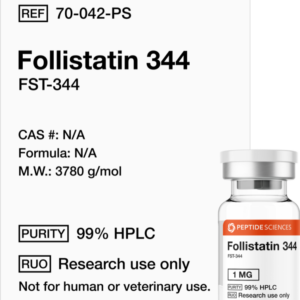
Follistatin 315 1mg for UK Laboratory Research
Follistatin 315 1mg is available through the Peptide Lab Sciences catalogue for laboratory research. This page brings together the named product quantity, a focused introduction to follistatin research, published references and practical questions to resolve before purchasing.
Choosing a research material involves more than matching a product name. Researchers also need to consider the specified isoform, supporting documentation and the requirements of their experimental model. These details help determine whether a particular preparation is appropriate for a planned investigation.
Use this guide to review Follistatin 315 1mg alongside your laboratory’s purchasing criteria. Where a specification is essential but not stated, request clarification before ordering. Published research provides background about the molecule; it does not verify the identity, composition or performance of an individual commercial batch.
You can also explore our research peptides catalogue to compare other named research materials.
All materials on this page are presented for laboratory research. They are not offered for personal administration, bodybuilding, treatment or use in humans or animals.
Follistatin 315 1mg Product Overview
The following overview separates the product’s stated name and quantity from information that requires supporting documentation.
| Product detail | Information |
|---|---|
| Product name | Follistatin 315 1mg |
| Named material | Follistatin 315 |
| Stated quantity | 1mg |
| Catalogue category | Research Peptides |
| Scientific context | Follistatin isoforms and activin-binding research |
| Physical format | Confirm against the current specification |
| Production system | Request supporting information if required |
| Purity and identity testing | Review documentation for the supplied batch |
| Storage requirements | Follow the applicable product specification |
| Intended use | Laboratory research only |
The product name does not independently establish the expression system, formulation, biological activity or analytical method used. Those details should be assessed separately when they affect your project.
For institutional purchasing, retain a copy of the specification reviewed at the time of ordering. This gives your laboratory a clear record of the information used to select the material.
What Is Follistatin 315?
Follistatin is an activin-binding protein with several molecular forms. Scientific literature describes core sequences of 315 and 288 amino acids, commonly identified as FS-315 and FS-288. Research has also examined molecular variation associated with processing and glycosylation.
These distinctions matter because a general reference to “follistatin” may not identify the exact material used in a study. A paper discussing one form should not automatically be treated as evidence for every other form or commercial preparation.
For readers evaluating Follistatin 315 1mg, the useful starting point is therefore precise identification. Check whether the research you intend to follow explicitly names FS-315 and whether its material description can be compared with the specification available for this product.
The original study of follistatin molecular forms provides background on the distinction between isoforms. It supports the importance of accurate terminology, rather than treating all follistatin preparations as interchangeable.
Why the Isoform Name Matters
Product names can look similar while describing different research materials. Follistatin 315, follistatin 288 and other follistatin-related preparations should therefore be recorded with their full identifiers.
Before selecting Follistatin 315 1mg, review the materials section of the paper or protocol that informs your project. Look for the isoform, source, preparation details and any qualification data supplied by the authors.
If those details are missing, record the uncertainty. A similar name alone is not enough to establish a close methodological match.
This approach is especially useful when several people contribute to a project. A purchasing officer may work from a catalogue title, while a researcher works from a paper and a laboratory manager maintains inventory records. Using the same complete material identifier across those records reduces avoidable ambiguity.
What Does the 1mg Quantity Mean?
The “1mg” in Follistatin 315 1mg describes the stated product amount. It does not specify a working concentration, a biological activity value or the number of experiments that the material will support.
Your laboratory should establish the basis of the quantity declaration when that distinction matters. For example, a purchasing specification may need to distinguish the amount of the named protein from the total contents of a preparation containing other ingredients.
Do not infer those details from a photograph, a price or a short catalogue title. Ask for the relevant specification and compare it with the requirements of your planned work.
A clear quantity record should remain linked to the original product identifier and batch reference. This allows researchers to trace how the material was described when it entered the laboratory.
Seven Essential Checks Before Ordering Follistatin 315 1mg
Use these seven checks to organise your purchasing review. They are questions to resolve against available information, rather than claims that every document or test is supplied.
1. Confirm the named isoform.
Check that your project calls for Follistatin 315 and that the supporting specification identifies the intended material clearly.
2. Confirm the quantity basis.
Establish what the stated 1mg represents and whether any formulation components require separate consideration.
3. Review the physical format.
Confirm the supplied presentation rather than assuming that a research protein is provided in a particular form.
4. Check available identity documentation.
Look for an identifiable report, method and sample reference where identity testing is available.
5. Review any activity evidence.
If your project depends on a functional property, determine whether relevant activity information exists for the preparation.
6. Confirm handling and storage requirements.
Obtain instructions applicable to the supplied material and incorporate them into your laboratory’s procedures.
7. Record the purchasing decision.
Keep the reviewed specification, order reference and any written clarification together.
Completing these checks before purchasing Follistatin 315 1mg makes it easier to identify missing information while there is still time to resolve it.
Published Research on Follistatin Isoforms
Research into follistatin includes studies of molecular forms, activin interactions and differences between experimental preparations. The references below provide specific starting points for a literature review.
A study of follistatin isoforms compared their ability to neutralise activin signalling and reported differences between FS-288 and FS-315 under the conditions examined. Its findings illustrate why the exact isoform and experimental method belong in any comparison.
Read the primary study comparing follistatin isoforms and activin signalling for the original research context.
Another investigation examined activin processing in rat pituitary cells and the role of follistatin associated with cell-surface heparan sulfate. This is evidence from a defined experimental system, rather than a general statement about every application of follistatin.
The study of follistatin and activin processing in pituitary cells provides a further reference for researchers reviewing this area.
These publications concern research materials and experimental observations. They do not constitute testing of the Follistatin 315 1mg product offered on this page.
How to Read Research References Critically
Start with the question the investigators actually tested. Then examine the materials, model, measurements and limitations before considering how the findings relate to your own work.
A useful literature review records:
- The exact material and isoform named by the authors
- The source and preparation details they provide
- The experimental system used
- The outcome measured
- The controls included
- The limitations discussed
- Any differences from your intended project
Avoid relying on an abstract headline or a commercial summary alone. Where a decision depends on a particular result, consult the full paper if available.
When evaluating Follistatin 315 1mg, keep the literature review separate from the product qualification record. The first concerns scientific background. The second concerns the actual material your laboratory intends to purchase and use.
Both are useful, but they answer different questions.
Identity, Purity and Activity Documentation
A product description should make it possible to identify what further evidence your project requires. Three useful questions are: what is the material, what does the preparation contain, and what functional evidence is available?
Do not assume that one reported result answers all three questions. Read the report’s stated purpose and method, then assess whether it addresses the property relevant to your experiment.
For Follistatin 315 1mg, request clarification if a specification uses a broad term such as “tested” without identifying the test or linking it to a sample.
Where numerical results are supplied, retain their units, method and sample reference in your records. A number copied without its context may be difficult to interpret later.
Visit our quality control information page when reviewing the information available from Peptide Lab Sciences. For additional requirements, contact us before purchasing.
Reviewing a Certificate of Analysis
If a certificate of analysis is available, check whether it applies to the material being supplied. A document for another batch or a differently named preparation may not answer your purchasing question.
Review the product identifier, batch reference, report date and the tests actually included. Check whether the document distinguishes measured results from specification limits.
For Follistatin 315 1mg, useful follow-up questions may include whether the report covers identity, composition or a particular functional assessment. The relevance of each question depends on your project.
Do not treat a certificate as a substitute for reading its contents. Equally, avoid assuming that a test was performed simply because it would be useful.
If an essential property remains undocumented, resolve that gap through your laboratory’s purchasing and qualification process before committing the material to a study.
Comparing Research Products Fairly
A useful comparison begins with matching specifications. Two products with similar names and quantities may still require different purchasing decisions if their documentation or preparation details differ.
When comparing Follistatin 315 1mg with another listing, record the information available for each product in the same format. This makes differences easier to identify without relying on marketing language.
Consider the named isoform, quantity basis, physical presentation, available reports and support for questions about the material. Leave unknown fields clearly marked as unknown.
Price can then be considered alongside the information needed for your project. A lower or higher price does not, by itself, establish identity, suitability or analytical quality.
Our research materials category provides a starting point for browsing the catalogue. Evaluate each product against its own specification.
Planning Your Laboratory Purchase
Before ordering, agree on the requirements that are essential to the project and the information that would simply be useful to have. This helps keep purchasing decisions focused.
For example, the principal investigator may require a particular material identifier, while the receiving laboratory may need specific documentation before accepting the shipment into inventory.
Record these requirements before selecting Follistatin 315 1mg. If several colleagues must approve the purchase, share the same specification and written clarifications with everyone involved.
Include the delivery address, receiving contact and internal order reference in your purchasing records. Check the delivery options and terms presented during ordering.
When additional details are needed, use our contact page and identify the product by its complete name. A precise enquiry is easier to answer than a general question about “follistatin.”
Receiving Follistatin 315 1mg
When the shipment arrives, compare the supplied label and accompanying information with your purchase record. Record the date of receipt and the person responsible for accepting the material.
Check for discrepancies in the product name, quantity declaration or batch reference. Document any visible packaging issue and follow your institution’s receiving procedure.
Keep Follistatin 315 1mg linked to its original order information when it enters your inventory. If your laboratory assigns an internal sample code, retain a clear connection between that code and the supplier’s identifier.
This allows a future reviewer to trace the material without relying on the memory of the person who placed the order.
Where information is inconsistent or unclear, seek clarification before proceeding with experimental work.
Storage and Handling Information
Use storage and handling information applicable to the supplied preparation. This page does not provide a universal temperature, solvent, shelf life or preparation method.
Before purchasing Follistatin 315 1mg, establish whether the information available is sufficient for your laboratory to receive and manage it appropriately.
If the specification distinguishes unopened material from material that has been prepared for laboratory work, preserve that distinction in your records.
Laboratory personnel should follow their validated procedures and the relevant product documentation. They should also record any departure from those procedures that could affect later interpretation.
Avoid importing instructions from an unrelated product page simply because the name appears similar. When the required information is missing, obtain clarification rather than filling the gap with an assumption.
Building a Traceable Experimental Record
A clear experimental record should identify the material used and the basis on which it was selected. Include the full product name, supplier, batch reference where available and the laboratory’s internal identifier.
For work involving Follistatin 315 1mg, retain the specification reviewed during purchasing together with any subsequent clarification. Record which version of a protocol was followed and where the supporting literature is stored.
If the project later changes suppliers or preparations, document that change explicitly. Do not allow a shared shorthand name to hide a change in material.
This record also helps when a colleague repeats the work or prepares a methods section. They can consult the documented information instead of reconstructing the purchase from emails and old labels.
Frequently Asked Questions
1. What is Follistatin 315 1mg?
It is the product name for the Follistatin 315 material listed here with a stated quantity of 1mg. Review the current specification and available documentation to establish the details of the supplied preparation before purchasing.
2. What does “315” identify?
The number identifies the follistatin isoform named in the product title. Use the complete name when comparing literature, specifications and inventory records so that references to different follistatin preparations remain distinguishable.
3. Does 1mg describe a working concentration?
No. A mass declaration alone does not specify a concentration. It also does not establish a functional activity value or an experimental method. Your laboratory must determine the requirements of its own validated research procedures.
4. Is this product interchangeable with Follistatin 288?
Do not assume interchangeability. Check the exact material required by your project and compare the supporting specifications. A substitution should be evaluated within the experimental design and documented clearly.
5. Is Follistatin 315 1mg a blend?
The listing names one research material. That does not establish whether the supplied preparation includes formulation ingredients. Request composition information if your project needs to account for buffers, carriers or other components.
6. Is the production method confirmed by the title?
No. The title alone does not establish the production system or preparation method. If those details are important to your experiment, request the relevant specification before ordering.
7. Does the product come with a certificate of analysis?
Check the documentation available for the batch being supplied. Do not assume that a certificate exists or that it includes a particular test. Contact Peptide Lab Sciences if your purchasing process requires specific evidence.
8. Do the linked papers test this commercial product?
No. The references provide scientific background. They should not be interpreted as validation of this supplier’s product or an individual batch. Product qualification requires documentation relevant to the actual material supplied.
9. How should Follistatin 315 1mg be stored?
Follow the instructions applicable to the supplied preparation and your laboratory’s procedures. Request clarification where necessary. This page does not make a universal storage or shelf-life claim.
10. Is this material intended for human use?
No. The product is presented for laboratory research only. It is not supplied for consumption, personal administration, treatment, bodybuilding or veterinary use.
11. Can I request additional information before ordering?
Yes. Identify the complete product name and explain the specification or document your laboratory needs. Include any relevant purchasing reference so the enquiry can be connected to the correct material.
12. Where can I compare other research materials?
Browse the research catalogue and review each product individually. Use the same purchasing checklist across listings, while allowing for differences in the type of material and the information needed for your project.
Review Follistatin 315 1mg Before Ordering
Select Follistatin 315 1mg by matching the named material and available specification to your laboratory’s requirements. Review the stated quantity, resolve essential documentation questions and keep a record of the information used in your decision.
The linked studies offer a starting point for understanding the research context. Your experimental design and material qualification process determine whether a particular preparation is suitable for the work you intend to perform.
For product or documentation enquiries, contact Peptide Lab Sciences before placing your order. Include the complete product name and the specific information you need.
For laboratory research only. Not for human or veterinary use, consumption, injection, diagnosis, treatment or personal administration.
Reviews
There are no reviews yet.