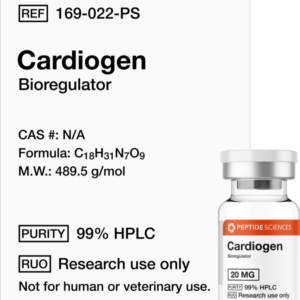
Cardiogen 20mg for Laboratory Research
Cardiogen 20mg is a peptide bioregulator listed in the Peptide Lab Sciences catalogue for laboratory investigation. The product is associated with cardiovascular cell biology, cardiac tissue signalling, contractile protein research, mitochondrial processes and cellular responses to stress.
This page gives researchers a structured way to review the material before ordering. A suitable purchasing decision requires more than a product name or a general reference to heart research. The research team should examine the stated quantity, identity information, physical presentation, formulation details and any available analytical documentation.
Cardiogen 20mg is offered as a laboratory research material. It is not intended for human or veterinary use, consumption, personal administration, injection or treatment. Scientific references describe research context and do not certify the identity, quality or performance of a particular commercial batch.
Understanding the Cardiogen Name
Cardiogen is described in the catalogue as a peptide bioregulator derived from cardiac tissue research. The product page describes a short synthetic peptide composed of alanine, glutamic acid, aspartic acid and arginine.
A sequence description is useful for identity review, but it does not provide every detail required for procurement. Researchers may also need to confirm the chemical form, stated amount, physical presentation, formulation, analytical result and batch reference.
When reviewing Cardiogen 20mg, compare the complete product information with the material specified in your research plan. If your project requires a defined sequence or other identifier, confirm that information before approving the purchase.
Use the complete product name in purchasing, receiving and inventory records. This prevents confusion with similarly named cardiac research materials or other bioregulators.
What the 20mg Quantity Means
The Cardiogen 20mg listing identifies twenty milligrams of material. This number describes the stated amount supplied with the product. It does not describe a personal dose, experimental concentration, preparation method or guaranteed number of tests.
Quantity and concentration are different measurements. The laboratory method determines how much material is required for a particular analysis or model. That decision should come from qualified researchers and approved procedures.
Before ordering Cardiogen 20mg, check whether the amount applies to one container, a package or a selected variation. Compare the listing with the basket and the laboratory’s approved purchasing request.
If the exact presentation is not clear, contact Peptide Lab Sciences and ask for the detail required by your project. Keep the response with the purchasing record.
Cardiogen 20mg Specification Overview
Review the following items against the exact material being considered.
| Specification item | Information to confirm |
|---|---|
| Product name | Cardiogen 20mg |
| Catalogue category | Peptide bioregulator |
| General research area | Cardiac and cellular biology |
| Stated quantity | 20mg |
| Sequence information | Confirm through the product specification |
| Physical format | Check the supplied presentation |
| Additional constituents | Review formulation information |
| Analytical documentation | Check available reports and scope |
| Batch identification | Match records to the supplied material |
| Storage information | Follow product-specific guidance |
| Intended use | Laboratory research only |
A complete specification allows the research team to determine whether the item fits the project. If an important field remains unknown, identify the gap instead of filling it through assumption.
Retain the information used during the review. The receiving team can then compare the delivered product with the approved request.
Cardiovascular Research Context
Cardiovascular research examines the cells, tissues and signalling pathways involved in heart structure and function. Laboratory projects may include cardiomyocytes, fibroblasts, contractile proteins, calcium handling, mitochondrial activity, oxidative stress or tissue remodelling.
Cardiogen 20mg is listed within this context because the product description associates it with myocardial gene expression and cardiac-cell processes. These terms identify areas of investigation rather than guaranteed outcomes.
A project using Cardiogen 20mg should define the endpoint before selecting the material. The endpoint might involve a gene-expression measurement, a cellular viability marker, a mitochondrial assay or another outcome approved by the research team.
A broad phrase such as “heart support” does not provide enough detail for a reproducible experiment. Replace broad language with a clearly defined question and measurable method.
Cardiomyocyte Research
Cardiomyocytes are specialised cardiac muscle cells responsible for contraction. Research involving these cells may examine contractile proteins, calcium movement, energy production, stress responses or changes in cell survival.
The Cardiogen 20mg listing refers to cardiomyocyte research, but the product page does not establish that every commercial preparation has been tested in the exact model used by your laboratory.
When reviewing a study, identify the cell source, culture conditions, exposure conditions and measurements. Compare those details with your proposed work before treating the paper as directly relevant.
A cellular observation should remain within the scope of the model that produced it. It should not automatically be expanded into a statement about intact tissue, an animal or a person.
Fibroblast and Tissue-Remodelling Research
Cardiac fibroblasts contribute to extracellular-matrix organisation and tissue remodelling. Laboratory studies may examine their proliferation, migration, collagen-related activity or response to inflammatory and mechanical signals.
Cardiogen 20mg is described as a material of interest in fibroblast and remodelling research. Researchers should confirm which findings are supported by original studies and which statements are general catalogue descriptions.
A change in fibroblast activity does not automatically demonstrate improved cardiac function. The meaning of an observation depends on the model, controls, endpoint and limitations reported by the investigators.
If your project concerns tissue remodelling, describe the relevant marker or measurement before deciding whether the product is appropriate.
Contractile Protein Research
Contractile proteins help cardiac muscle cells generate force. Research may investigate the expression, organisation or function of proteins involved in cardiac contraction.
The product description links Cardiogen 20mg with contractile protein synthesis. This association should be treated as research context. It does not establish that the listed product produces a defined change in every experimental system.
When comparing the literature with your project, identify whether the publication measured protein abundance, gene expression, functional contraction or another endpoint. These measurements answer different questions.
Use the term “contractile protein research” precisely in your records. Avoid changing a specific molecular observation into a broad claim about performance.
Calcium-Handling Research
Calcium ions participate in the contraction and relaxation of cardiac muscle cells. Laboratory investigations may assess calcium entry, release, storage or recovery after stimulation.
The Cardiogen 20mg catalogue description mentions calcium homeostasis. Researchers should determine whether the available evidence concerns a direct measurement of calcium handling or a related signalling pathway.
A project that measures calcium dynamics needs a method suited to that endpoint. The product name alone does not confirm that the material is appropriate for the selected assay.
Record the method, model and interpretation criteria before starting the work. This helps prevent a general biological description from becoming an unsupported experimental expectation.
Mitochondrial Bioenergetics
Mitochondria provide energy for many cellular processes, including the high energy demand associated with cardiac muscle activity. Research may examine respiration, membrane potential, ATP production, oxidative stress or metabolic adaptation.
Cardiogen 20mg is associated with mitochondrial research in the product description. That association identifies a possible area of scientific interest, not a guarantee of improved energy production or cellular performance.
When reviewing a mitochondrial study, identify the assay used and the conditions under which the measurement was made. A change in one mitochondrial marker may not represent a change in all aspects of cellular bioenergetics.
Define which endpoint your project needs and assess the material against that requirement.
Cellular Stress and Oxidative Research
Cardiac cells can respond to oxidative, metabolic and inflammatory stress. Researchers may use controlled models to examine antioxidant responses, signalling changes, cell survival or tissue-associated markers.
The Cardiogen 20mg listing refers to stress-response mechanisms. Interpret this language within the specific experimental evidence available.
If a paper examines a particular stressor or cell model, record those conditions. Do not assume that the same observation applies to an unrelated system or formulation.
A careful research plan explains how the stress model will be created, what will be measured and which result would support the working hypothesis. Product selection should follow that plan.
Reading Scientific Literature
Original publications provide the methods and limitations needed to interpret research accurately. A short summary can help locate a source, but it cannot replace the paper’s description of the material and experiment.
When reviewing Cardiogen 20mg research, record the publication title, identifier, preparation, model and primary endpoint. Note whether the paper investigates Cardiogen itself, a related peptide or another cardiac material.
The product page provides references associated with Cardiogen, but those citations should be checked against the original publication before being used in a formal research plan.
For broader peptide research context, the following source can help illustrate how cellular peptide studies are designed:
Peptide regulation in a human monocytic cell model.
This source concerns several peptide preparations and a THP-1 cellular model. It should not be treated as direct validation of Cardiogen 20mg.
Separating Literature Evidence from Product Evidence
Scientific literature and product documentation answer different questions.
A publication may explain how investigators studied a compound and what they observed under defined conditions. Product documentation should identify what the supplier represents as being offered and what information is available for the supplied material.
For Cardiogen 20mg, do not use a scientific paper as a substitute for a batch-specific document. Do not use a product label as proof that every finding in a paper applies to the supplied item.
Record three separate points:
- What the publication reports.
- What the product documentation establishes.
- What the laboratory project requires.
Keeping these points separate makes the purchasing decision easier to review and reduces overstatement.
Comparing Cardiogen with Other Bioregulators
A shared category does not make two materials interchangeable. Other peptide bioregulators may differ in sequence, quantity, formulation, research history and available documentation.
When comparing Cardiogen 20mg with another bioregulator, review the complete identity information for both products. Check whether the project requires a single named material or a defined combination.
Packaging and price may help with purchasing logistics, but they do not establish molecular equivalence. A similar image or description also does not confirm that two products can be substituted.
Create a comparison record containing the product name, stated amount, physical presentation, supporting documents and unresolved questions.
Individual Materials and Peptide Blends
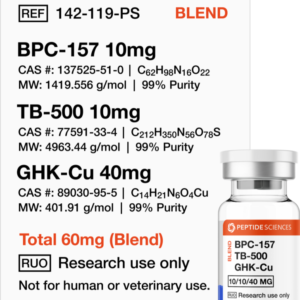
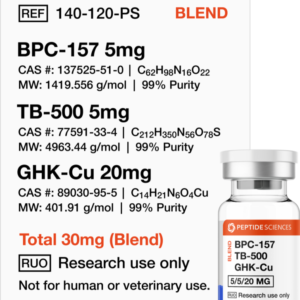
An individual bioregulator and a peptide blend represent different formulation choices. Cardiogen 20mg is presented as one named material, while a blend contains multiple identified components.
If your project requires separate control over each component, an individual listing may be easier to evaluate. If your project examines a mixture, the complete blend composition becomes essential.
Review the research peptides catalogue for individual materials. Visit the peptide blends category to compare combinations.
Do not infer the amount of each component from the total mass of a blend. Review the complete ingredient list and quantity assigned to every constituent.
Reviewing Cardiogen 20mg Documentation
Documentation connects a catalogue listing with the material the laboratory intends to receive. Depending on availability, it may include a product specification, analytical report, batch identifier or handling information.
For Cardiogen 20mg, identify what each document establishes. Check the material name, sample reference, reported tests and stated findings.
A general reference may describe the compound without establishing characteristics for a particular batch. If the relationship between a document and the product is unclear, request clarification before relying on it.
Visit the quality control page to review information made available by Peptide Lab Sciences.
Understanding Analytical Reports
An analytical report answers questions addressed by its methods. A single result does not automatically describe every property of a material.
When reviewing a report for Cardiogen 20mg, identify whether it concerns identity, composition, purity, stability or another characteristic. Then decide whether that property matters to your project.
If interpretation requires specialist knowledge, refer the report to a qualified laboratory reviewer. Keep notes explaining how the document supports the purchasing decision.
Avoid treating an isolated percentage or short quality statement as a complete description. Documentation is useful when it is connected to the exact material and interpreted within its stated scope.
Certificates and Batch Traceability
A certificate is most useful when the laboratory can connect it to the product and batch received.
For each Cardiogen 20mg order, retain the product name, quantity, order reference and available batch information. Store the documentation with the inventory record.
If a certificate concerns an earlier purchase, determine whether it applies to the new order. The earlier document may describe another batch, presentation or preparation.
Record any clarification received from Peptide Lab Sciences and keep it with the original document. This allows later reviewers to understand the basis for accepting the information.
Preparing a Purchasing Request
A clear purchasing request identifies the intended item without requiring the purchaser to interpret an informal description.
Include the full title Cardiogen 20mg — Research Peptide Bioregulator, the product page, required quantity and documentation conditions established by your laboratory.
Identify the receiving laboratory and the person responsible for checking the delivery. Complete any internal approval required by your organisation before submitting the order.
Keep the approved request with the order confirmation. These records show what was requested, what was selected and which information supported the decision.
Questions Before Checkout
Ask focused questions about the details that affect your project. A specific request for the physical format or batch connection of a report is more useful than a general request for reassurance.
When contacting Peptide Lab Sciences about Cardiogen 20mg, include the product page and identify the missing information. Ask whether the stated quantity applies to the selected item, whether analytical documents are available and how the material is identified.
Use the contact page for product, documentation and order enquiries. Save the response with the purchasing record.
If a necessary detail remains unavailable, record that limitation and allow the research team to decide whether the available information is sufficient.
Checking the Basket and Delivery Details
Before checkout, compare the basket with the approved request. Confirm the product title, quantity, number of items and delivery address.
For Cardiogen 20mg, review the delivery options shown for your destination. Avoid planning a time-sensitive experiment around an assumed arrival date.
Tell the receiving team what to expect and who will inspect the item. Keep the order reference accessible if a delivery question arises.
If the project depends on receipt within a specific period, clarify the available delivery arrangements before ordering.
Receiving Cardiogen 20mg
When the delivery arrives, compare the product label and accompanying documents with the approved request. Check the name, quantity, physical presentation and available batch details.
Enter Cardiogen 20mg into inventory using a consistent description. Link the entry to the order confirmation and supporting documents.
If the material differs from the approved request, document the discrepancy and contact the supplier. Follow the laboratory’s receiving procedure while the issue is reviewed.
Do not resolve a meaningful difference by relying on packaging or appearance. Clear receipt records help identify which material was accepted and which information was available.
Storage and Handling Information
Follow the product-specific storage and handling information supplied for the material, together with your laboratory’s approved procedures.
Do not apply instructions from another peptide or another supplier’s listing without confirming that they concern the same preparation. Physical format and formulation may affect handling requirements.
Before handling Cardiogen 20mg, ensure that responsible personnel can access the relevant specification and safety information.
This page does not assign a universal storage temperature, preparation method or shelf life. Those details require product-specific evidence and a laboratory assessment.
Maintaining Research Records
A consistent record allows colleagues to understand which material was used in a project. Establish the naming convention before the product enters inventory.
Where Cardiogen 20mg appears in a notebook, spreadsheet or analysis file, connect it with the laboratory’s material identifier and available batch information.
Record changes in source, format or documentation. If the research team decides that a difference does not affect the project, document the reason for that decision.
Consistent records support later review and connect a purchase, stored container and experimental dataset.
Interpreting Findings Carefully
A finding should be described within the limits of the model and method that produced it. A cellular observation does not automatically establish a tissue-level or human outcome.
When interpreting findings involving Cardiogen 20mg, keep the literature, product documentation and project requirements separate.
Avoid turning a research description into a promise about cardiac performance, regeneration or general health. The purpose of the material review is to select a suitable candidate for investigation and describe uncertainty accurately.
If the project produces an unexpected result, review the material record, method and experimental conditions before assigning a cause.
Frequently Asked Questions
1. What Is Cardiogen 20mg?
Cardiogen 20mg is a product listed as a peptide bioregulator for laboratory research. The catalogue associates it with cardiac-cell biology, tissue signalling and cellular stress research. Review the exact specification before determining whether it fits your project.
2. What Does the 20mg Quantity Describe?
It describes the stated amount of material in the listing. It is not a personal dose, preparation method or experimental concentration. Laboratory requirements should be established through approved procedures.
3. Is Cardiogen a Peptide?
The product is described as a short synthetic peptide bioregulator. Confirm the identity information supplied for the exact material before comparing it with another preparation or publication.
4. What Research Areas Are Associated with Cardiogen?
The listing refers to myocardial gene expression, contractile proteins, calcium homeostasis, mitochondrial bioenergetics and cardiac-cell repair models. These are research areas and do not guarantee a specific result.
5. Can Cardiogen Be Used as a Treatment?
This product is presented for laboratory research and is not intended for human or veterinary use, consumption or personal administration. The page does not provide treatment or dosing instructions.
6. Can a Scientific Paper Verify This Product?
No. A paper describes the material and methods used by its authors. It does not independently verify a separate supplier’s commercial batch. Evaluate the product through its own specification and documentation.
7. Does Cardiogen 20mg Include a Certificate?
Confirm what documentation is available for the material being offered. Review the document’s scope and connection to the relevant batch before treating it as evidence for your project.
8. How Do I Compare Cardiogen with Another Bioregulator?
Compare identity, stated quantity, format, formulation and supporting documentation. Similar packaging or category placement does not establish equivalence.
9. Can I Substitute a Different Cardiac Peptide?
Not automatically. A different peptide may have a different sequence, formulation and research history. The proposed substitute should be assessed against the project requirements.
10. How Do I Confirm the Product Quantity?
Check the exact listing and selected option. Compare the basket with the approved request. If the amount is unclear, contact Peptide Lab Sciences before ordering.
11. What Should I Ask Before Purchase?
Ask about any information essential to your project, such as identity, physical format, quantity or batch documentation. Include the exact product page in your enquiry.
12. What Should I Check When the Product Arrives?
Compare the name, stated quantity, presentation and batch details with the approved request. Retain documents and record discrepancies through your receiving procedure.
13. How Should Cardiogen 20mg Be Stored?
Follow the guidance applicable to the supplied preparation and your laboratory’s procedures. Do not use a universal instruction from another product. Request clarification if the relevant information is missing.
14. Can an Earlier Report Be Used for a New Order?
Not necessarily. An earlier report may concern another batch or preparation. Review the documents associated with the new order and establish their relevance.
15. How Do I Decide Whether Cardiogen Fits My Project?
Compare the confirmed specification with the requirements established by your research team. Review relevant literature, identify unresolved information and assess available documentation before approval.
Review Cardiogen 20mg Before Ordering
Review Cardiogen 20mg with a clear objective. Confirm the material identity, stated quantity, physical presentation and documentation required by your laboratory.
Use scientific literature to understand the research context while assessing the supplied product through its own specification and records. Keep the approved request, order confirmation and receiving documentation together.
If an essential detail remains unresolved, contact Peptide Lab Sciences before completing the order. The receiving team should compare the delivered item with the approved request and record the outcome.
For laboratory research only. Not for human or veterinary use. Not for consumption or personal administration.
Reviews
There are no reviews yet.