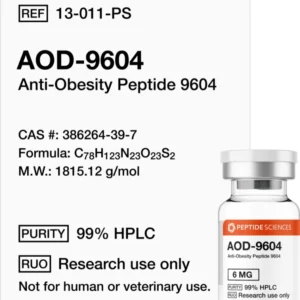
AOD9604 6mg for Laboratory Research
AOD9604 6mg is a synthetic research peptide listed in the Peptide Lab Sciences catalogue for controlled laboratory investigation. The product is associated with studies of lipid metabolism, adipose-tissue signalling, lipolysis-related pathways, energy balance and metabolic response models.
AOD9604 is commonly described as a modified fragment related to the C-terminal region of human growth hormone. The product page identifies the material as corresponding to the hGH 176–191 region and describes a disulfide bridge. Researchers should confirm the exact identity and formulation through the product specification before using the material in a research plan.
This page explains how to review AOD9604 6mg, interpret published research and prepare a documented purchasing decision. The product name and quantity provide a starting point, but the laboratory should also consider the physical presentation, formulation, available analytical documents and batch information.
AOD9604 6mg is supplied for laboratory research only. It is not intended for human or veterinary use, consumption, personal administration, injection, weight-loss treatment or disease management. Scientific references describe experimental context and do not certify the quality or performance of a particular commercial batch.
Understanding the AOD9604 Name
AOD9604 is used in the scientific literature to describe a synthetic peptide fragment associated with the lipolytic domain of human growth hormone. The name identifies the research subject, but it does not describe every characteristic of a commercial product.
Researchers may need to verify the sequence, chemical form, disulfide arrangement, stated quantity, physical format, formulation and analytical documentation. These details should come from the applicable product record or supporting documents.
When reviewing AOD9604 6mg, compare the complete product name with the material specified in your research plan. If the project requires a particular sequence or molecular form, confirm that requirement before approving the purchase.
Use the full product title in purchasing and inventory records. A consistent name helps distinguish AOD9604 from full-length growth hormone, other growth-hormone fragments and unrelated metabolic research compounds.
What the 6mg Quantity Means
The AOD9604 6mg listing states six milligrams of material. This number identifies the listed quantity. It does not describe a personal dose, experimental concentration, preparation method or guaranteed number of assays.
Quantity and concentration are different measurements. The laboratory method determines the amount used in a particular model. That decision should come from qualified personnel and approved procedures.
Before ordering AOD9604 6mg, confirm whether the quantity applies to one container, a package or a selected variation. Compare the product page with the basket and the approved purchasing request.
If the amount or presentation is unclear, contact Peptide Lab Sciences before checkout. Keep the response with the purchasing record so that the receiving team can verify what was confirmed.
Do not estimate the number of experiments a product will support from the mass alone. That assessment depends on the model, assay volume, controls, repeat requirements and laboratory acceptance criteria.
AOD9604 6mg Specification Overview
Review each specification item against the exact material being considered.
| Specification item | Information to confirm |
|---|---|
| Product name | AOD9604 6mg |
| Catalogue category | Research Peptide |
| General research area | Lipid metabolism and adipose-tissue biology |
| Stated quantity | 6mg |
| Sequence description | Review the available product specification |
| Structural information | Confirm the stated fragment and bridge information |
| Physical presentation | Check the supplied format |
| Additional constituents | Review formulation details |
| Analytical documentation | Check available reports and their scope |
| Batch identification | Match documents to the supplied material |
| Storage information | Follow product-specific guidance |
| Intended use | Laboratory research only |
A complete specification helps researchers decide whether the product fits the project. If an essential field remains unknown, record the limitation rather than completing the gap through assumption.
Retain the information used to approve the purchase. The receiving team can then compare the delivery with the accepted specification.
AOD9604 and Growth-Hormone Fragment Research
AOD9604 is often discussed as a modified fragment of human growth hormone rather than as full-length growth hormone. This distinction matters when comparing literature, methods and product descriptions.
The product page refers to the hGH 176–191 region. Researchers should verify whether the exact product specification uses the same numbering convention and structural description as the study they intend to review.
A growth-hormone fragment and full-length growth hormone are different research materials. Evidence about one should not automatically be transferred to the other.
When preparing a research plan, identify the exact compound, model and endpoint. This prevents a familiar growth-hormone term from obscuring the distinction between related but separate materials.
Lipid-Metabolism Research
Lipid metabolism includes the processes through which cells store, mobilise, transport and use fats. Laboratory projects may examine triglyceride breakdown, fatty-acid handling, adipocyte activity, lipid oxidation or related signalling pathways.
AOD9604 6mg is listed in this research context because preclinical studies have investigated its relationship with lipid-metabolism markers and adipose-tissue responses.
These research areas do not establish that a commercial preparation causes a defined change in body weight or fat mass. Interpretation depends on the model, conditions and measured endpoint.
If your project concerns lipid metabolism, define the relevant marker or assay before selecting the material. A broad phrase such as “fat burning” does not provide enough detail for a reproducible study.
Lipolysis and Lipogenesis
Lipolysis refers to the breakdown of stored triglycerides. Lipogenesis refers to the formation and storage of lipids. Researchers may measure these processes through biochemical markers, cellular assays or changes in tissue composition.
The product description associates AOD9604 with pathways related to lipolysis and lipogenesis. Researchers should identify which process was measured in the relevant study and whether the material matched the product being considered.
A result in cultured adipocytes may not represent the same response in an animal or human. Keep the interpretation within the evidence provided by the model.
When writing a project plan, state whether the study will evaluate enzyme activity, gene expression, lipid accumulation, oxidation or another specific endpoint.
Adipose-Tissue Models
Adipose tissue contains cells that store energy and participate in endocrine and metabolic signalling. Laboratory adipose models can include isolated adipocytes, tissue explants, genetically modified animals or other experimental systems.
AOD9604 6mg may be considered for research involving adipose-tissue metabolism. The suitability of the material depends on the model and the question the research team intends to answer.
Before relying on a publication, compare the study’s preparation, dose range, exposure conditions and measured outcomes with your proposed work. Differences should be recorded clearly.
A catalogue description cannot confirm that every preparation behaves identically in every adipose model. Product-specific evidence remains necessary.
Energy-Balance Research
Energy balance reflects the relationship between energy intake, storage and expenditure. Research may examine food intake, body composition, substrate oxidation or metabolic adaptation.
The product page refers to energy-balance pathways as an area of investigation. This does not establish a weight-loss effect or a therapeutic application.
If your project concerns energy balance, define what will be measured and how the data will be interpreted. A change in one metabolic marker may not represent a change in total energy expenditure.
Use AOD9604 6mg as an experimental material only within a documented research design that identifies the model, endpoint and controls.
Joint and Cardiovascular Research
The product page also mentions exploratory research involving joint and cardiovascular biology. These areas involve different tissues, mechanisms and experimental endpoints from adipose metabolism.
AOD9604 6mg should not be selected for a joint or cardiovascular project solely because those words appear in a catalogue description. Review the relevant literature and confirm whether the exact material has been studied in the model your laboratory intends to use.
A result concerning lipid metabolism does not automatically establish a result concerning cartilage, vascular tissue or cardiac function.
Keep each research question separate and describe the evidence that supports it.
Reading Original Research
Original publications provide the material descriptions, methods, models and limitations needed for careful interpretation.
The product page lists research references concerning AOD9604 and lipid metabolism. Researchers should review the original papers before using them in a formal research plan.
The following sources may help provide context:
- AOD9604 research in obese and beta-3 adrenergic receptor knockout mice
- Metabolic studies of a synthetic lipolytic domain of human growth hormone
- AOD-9604 metabolic research record
These publications describe defined research settings. They do not certify AOD9604 6mg from a separate commercial supplier.
Record the study material, model, endpoint and limitations before deciding how closely each paper relates to your proposed work.
Interpreting Animal and Cellular Findings
Animal and cellular studies can provide useful information about biological pathways, but their findings have a defined scope.
A result in an obese mouse model does not automatically establish the same effect in humans. A cell-culture observation does not automatically demonstrate a tissue-level response.
When reviewing AOD9604 6mg research, identify the experimental system and avoid extending the conclusion beyond that system.
This is particularly important for weight, adipose tissue and metabolic claims. A research result can support further investigation without proving a consumer or therapeutic outcome.
Separating Literature Evidence from Product Evidence
Scientific literature explains what researchers observed in a defined preparation. Product documentation explains what the supplier represents as being offered.
For AOD9604 6mg, do not use a publication as a substitute for a batch-specific analytical document. Likewise, do not use a product label as proof that every finding in a study applies to the supplied material.
Record three separate points:
- What the scientific literature reports.
- What the product documentation establishes.
- What the research project requires.
This structure makes the purchasing decision easier to review and helps identify questions that need clarification.
Comparing AOD9604 with Full-Length Growth Hormone
AOD9604 is described as a fragment related to human growth hormone. Full-length growth hormone is a different material with a different molecular structure and research profile.
When comparing AOD9604 6mg with full-length growth hormone, review identity, sequence, structure, formulation and intended endpoint.
Do not assume that findings about full-length growth hormone apply to a fragment. A shared association with growth-hormone biology does not establish equivalence.
The same principle applies to other hGH fragments. Confirm the exact material before comparing results or planning an experiment.
Comparing AOD9604 with Other Peptides
Other metabolic research peptides may have different sequences, targets, formulations and evidence bases.
When comparing AOD9604 6mg with another peptide, review the complete product identity, stated quantity, physical format and supporting documentation.
Price and packaging support purchasing logistics but do not establish molecular equivalence. A similar product image also does not prove that two materials can be substituted.
Create a comparison record containing the product name, quantity, format, documentation and unresolved questions.
Individual Materials and Peptide Blends
An individual peptide and a blend represent different formulation choices. AOD9604 6mg is presented as one named material, while a blend may contain several identified compounds.
If your project requires separate control over each component, individual materials may be easier to evaluate. If your project studies a mixture, every constituent and amount must be confirmed.
Review the research peptides catalogue for individual materials. Visit the peptide blends category to compare combination products.
Do not infer the amount of each blend component from the total mass. Review the complete formulation before treating two products as equivalent.
Reviewing AOD9604 6mg Documentation
Documentation connects the catalogue listing with the material the laboratory intends to receive.
For AOD9604 6mg, check whether the available documents identify the sequence, structural description, quantity, physical presentation and batch.
A general product summary may provide research background without establishing batch-specific characteristics. A report associated with another preparation should not be applied automatically.
Visit the Peptide Lab Sciences quality control page to review available information.
Analytical Reports and Certificates
An analytical report answers questions addressed by its methods. A certificate is most useful when the laboratory can connect it to the exact product and batch.
For each AOD9604 6mg order, retain the product title, quantity, order reference and available batch information. Review whether the report concerns the same preparation.
If the document does not address a property important to your project, identify that limitation. A report about one characteristic does not automatically establish every other characteristic.
Confirm the availability and relevance of documentation before making it a condition of purchase approval.
Preparing a Purchasing Request
A clear purchasing request identifies the intended material without requiring the purchaser to interpret an informal description.
Include the full title “AOD9604 6mg — Research Peptide,” the product page, required quantity and documentation conditions established by your laboratory.
If the project concerns a particular hGH fragment or structural feature, include that requirement in the internal request.
Identify the receiving laboratory and the person responsible for checking the delivery. Complete any required internal approval before ordering.
Keep the approved request with the order confirmation and supporting documents.
Questions Before Checkout
Ask focused questions about information that affects your project. Useful questions may concern sequence, disulfide-bridge information, physical format, quantity or batch documentation.
When contacting Peptide Lab Sciences about AOD9604 6mg, include the product page and identify the missing detail.
Use the contact page for product, documentation and order enquiries. Save the response with the purchasing record.
If a required detail remains unavailable, record that limitation and allow the research team to decide whether the material is suitable.
Reviewing the Basket and Delivery Details
Before submitting the order, compare the basket with the approved purchasing request. Confirm the product title, quantity, number of items and delivery address.
For AOD9604 6mg, review the delivery options shown for your destination. Avoid planning a time-sensitive experiment around an assumed arrival date.
Tell the receiving team what product to expect and who will inspect it. Keep the order reference accessible if a delivery question arises.
Receiving AOD9604 6mg
When the delivery arrives, compare the product label and accompanying documents with the approved request.
Check the product name, stated quantity, physical presentation and available batch information. Confirm that the delivered material corresponds to the identity reviewed before purchase.
Enter AOD9604 6mg into inventory using a consistent description. Connect the entry with the order confirmation and supporting documents.
If the label or documentation differs from the approved request, record the discrepancy and contact the supplier. Follow the laboratory’s receiving process while the issue is reviewed.
Storage and Handling Information
Follow the storage and handling information applicable to the supplied material together with your laboratory’s approved procedures.
Do not apply instructions from another peptide, another supplier or a different formulation without confirmation.
Before handling AOD9604 6mg, ensure that responsible personnel can access the relevant specification and safety information.
This page does not assign a universal storage temperature, preparation method or shelf life. Those details require product-specific evidence and laboratory assessment.
Maintaining Research Records
A consistent record allows colleagues to understand which material entered a project.
Where AOD9604 6mg appears in a notebook, spreadsheet or analysis file, connect it with the laboratory’s internal identifier, product page, order reference and available batch information.
Record changes in source, format or documentation. If the research team decides that a difference does not affect the project, document the basis for that decision.
Consistent records connect the purchase, stored container and experimental dataset.
Interpreting Findings Carefully
A finding should be described within the limits of the model and method that produced it.
A change in adipocyte metabolism does not automatically demonstrate weight reduction in people. A result in an animal model does not automatically establish human efficacy. A lipid marker does not necessarily represent overall metabolic health.
When interpreting findings involving AOD9604 6mg, keep the scientific literature, product documentation and project requirements separate.
Avoid turning a research description into a promise about fat loss, body composition or medical treatment.
Frequently Asked Questions
1. What Is AOD9604 6mg?
AOD9604 6mg is a product listed as a synthetic research peptide associated with lipid-metabolism and adipose-tissue studies. The stated quantity is six milligrams. Review the exact specification before ordering.
2. Is AOD9604 the Same as Full-Length Growth Hormone?
No. AOD9604 is described as a modified fragment related to the C-terminal region of human growth hormone. Full-length growth hormone is a different material.
3. What Does the 6mg Quantity Mean?
It identifies the listed amount of material. It is not a personal dose, experimental concentration or preparation instruction.
4. What Research Areas Are Associated with AOD9604?
Research descriptions include lipid metabolism, lipolysis-related signalling, adipose-tissue models, energy balance and exploratory metabolic studies.
5. Can AOD9604 Be Used for Weight Loss?
This product is supplied for laboratory research and is not intended for weight-loss treatment, human consumption or personal administration. Research findings do not establish a consumer or therapeutic outcome.
6. Can a Scientific Paper Verify This Product?
No. A paper describes the preparation and methods used by its authors. It does not independently verify a separate supplier’s commercial product or batch.
7. Does AOD9604 6mg Include a Certificate?
Confirm what documentation is available for the material being offered. Review the scope and batch connection of each document before relying on it.
8. How Do I Compare AOD9604 with Another Peptide?
Compare sequence, structural description, quantity, physical format, formulation and supporting documentation. Similar packaging or research language does not establish equivalence.
9. Is the hGH 176–191 Description Confirmed?
The product page uses that description. Researchers should confirm the exact sequence and structural information through the current product specification before relying on it.
10. Does the Product Contain a Disulfide Bridge?
The catalogue description refers to a disulfide bridge. Confirm the structural details for the exact supplied material before using them in a research plan.
11. How Do I Confirm the Product Quantity?
Check the exact listing and selected option. Compare the basket with the approved purchasing request. Contact Peptide Lab Sciences if the amount is unclear.
12. What Should I Ask Before Ordering?
Ask about the sequence, structural description, physical format, quantity and availability of relevant batch documentation.
13. How Should AOD9604 6mg Be Stored?
Follow the information applicable to the supplied preparation and your laboratory’s approved procedures. Request clarification if the relevant guidance is missing or unclear.
14. What Should I Check on Receipt?
Compare the product name, stated quantity, physical presentation and batch information with the approved request. Retain supporting documents and record discrepancies.
15. How Do I Decide Whether AOD9604 Fits My Project?
Compare the confirmed product specification with the requirements established by your research team. Review relevant literature, identify unresolved questions and assess available documentation before approval.
Review AOD9604 6mg Before Ordering
Review AOD9604 6mg with a clear purchasing objective. Confirm the material identity, fragment description, stated quantity, physical presentation and documentation required by your laboratory.
Use the scientific references to understand the research context while assessing the supplied product through its own specification and records. Keep the approved request, order confirmation and receiving documentation together.
If an essential detail remains unresolved, contact Peptide Lab Sciences before completing the order. The receiving team should compare the delivered product with the approved request and record the outcome.
For laboratory research only. Not for human or veterinary use. Not for consumption or personal administration.
Reviews
There are no reviews yet.