Peptide storage is a laboratory planning question, not simply a choice of freezer shelf. Researchers need to connect the exact material, its physical form and its handling history with the requirements of the intended experiment. A storage decision that works for one peptide cannot automatically be transferred to another sequence, formulation or supplier lot.
This guide explains how to build a practical storage record, identify unanswered questions before purchasing and respond to unexpected events. It concerns laboratory research materials only. It does not provide personal-use, dosing or administration instructions.
Start peptide storage planning before the order arrives
Identify who will receive the delivery, who can review its documentation and which approved storage location is available. These are separate responsibilities: a parcel can reach the correct building without reaching the laboratory staff who understand its requirements.
A useful purchasing enquiry asks for the supplied physical form, product-specific storage instructions, available shelf-life or retest information and any stated transport conditions. Avoid converting a generic website recommendation into a product specification. If important information is absent, record the gap and seek clarification before ordering.
Browse the Peptide Lab Sciences catalogue and the Research Peptides category to identify the precise listing. Category membership helps navigation; it does not establish a shared storage requirement.
Separate general handling guidance from product instructions
Bachem’s handling and storage guidance explains that peptide stability varies with sequence and physical form. It also discusses moisture uptake by lyophilised materials and the importance of keeping containers closed. These principles provide background for asking questions; they are not batch-specific evidence for a product purchased elsewhere.
Sigma-Aldrich’s peptide handling guidance identifies repeated freeze–thaw cycles as a concern and discusses working aliquots. Its general temperature recommendations must be interpreted alongside the exact product documentation and an approved laboratory method. A published guideline does not establish a universal expiry date.
Where documents conflict, preserve both versions and request a written explanation. Do not choose whichever instruction is easiest to follow. The responsible laboratory should resolve whether the difference reflects physical form, formulation, intended duration or a document error.
Build a peptide storage record that answers useful questions
The following table is a proposed record structure, rather than a regulatory form or a claim about the documentation supplied with every product.
| Record field | What to enter | Why it helps |
|---|---|---|
| Material identity | Complete name, catalogue reference and documented form | Distinguishes similar names and variants |
| Lot connection | Container lot and matching report reference | Connects handling history to the received material |
| Instruction source | Document title, version and date obtained | Makes the decision traceable |
| Receiving event | Date, staff member, packaging observations and available transport records | Separates observations from assumptions |
| Storage location | Equipment identifier and container position | Supports retrieval and investigation |
| Handling events | Dates removed, returned or subdivided under the approved method | Preserves the material’s history |
| Exceptions | Known deviation, evidence reviewed and disposition decision | Prevents unresolved questions being forgotten |
Use consistent identifiers across the inventory, notebook and analytical files. If a sample is subdivided, link each new identifier to its parent container. A label such as “peptide stock” provides too little context when several materials are stored together.
Distinguish dry material from laboratory solutions
Lyophilised material and a prepared solution represent different storage situations. General manufacturer guidance discusses limited solution stability and sequence-dependent sensitivities. Solvent, pH, container and preparation history therefore belong in a solution record; the original powder label alone cannot describe the prepared sample.
For a solution prepared under an authorised laboratory method, record the method reference, preparation date, preparer, solvent or buffer identity and assigned sample identifier. Record concentration only when its calculation and quantity basis are supported. This guide does not prescribe a solvent recipe or claim that a solution remains usable for a fixed period.
Before preparing anything, decide how the laboratory will assess suitability over the planned experiment. That may require method-specific controls or analytical checks. An administrative use-by date is useful for stock management, but it should not be mistaken for measured stability data.
Example: two containers with different handling histories
Consider a hypothetical laboratory receiving two containers from the same lot. Container A remains sealed in the assigned location. Container B is opened during several separate work sessions and later transferred to another laboratory. Both share the original lot number, but their subsequent histories differ.
The laboratory assigns separate inventory identifiers and records the transfer details for B. When an unexpected analytical result appears, staff can review which container was used and whether the relevant handling records are complete. They do not infer degradation solely because B was opened, or infer suitability solely because A remained sealed.
This example illustrates the value of traceability. It is not a stability study and provides no measured comparison between the containers. Evidence from the actual material and method remains necessary to explain the result.
Match catalogue illustrations with documented identity
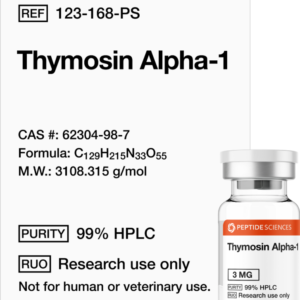
A product photograph can help locate a listing, but it cannot establish the delivered lot, current expiry information or storage history. Compare the actual container label with the order and accompanying documentation.
For listings such as Thymosin Alpha-1 or VIP 6MG, review the individual specification rather than assigning the same handling conditions because both appear in a peptide catalogue. These links identify catalogue examples; they do not recommend either material for an experiment.
Respond to a storage deviation with evidence
If equipment fails or a container is found outside its assigned location, document what is actually known. Record discovery time, equipment identity, affected sample identifiers and available monitoring records. Keep uncertain duration separate from measured duration.
Follow the laboratory’s deviation procedure and hold affected material from further use where required by that procedure. Ask the supplier for relevant information, stating the documented conditions and gaps. A room that felt cool or a package without an ice pack does not independently establish the material’s temperature history.
The final decision should identify who assessed the evidence, what additional checks were performed and whether restrictions apply. An unresolved deviation should remain visible in the inventory rather than disappearing when the container returns to storage.
Connect storage planning with workplace assessment
The UK’s HSE guidance on chemical safety data sheets explains that an SDS informs a workplace assessment but does not replace it. Apply the laboratory’s assessment to the actual tasks, materials and equipment involved. A COA answers different questions from an SDS.
For analytical context, see our guide to peptide purity testing and COAs. For questions to resolve before purchase, use the ordering documentation checklist. Neither document establishes stability for a specific stored sample.
Frequently asked questions
1. Is there one storage temperature for all research peptides?
No. Follow product-specific documentation and the laboratory’s approved procedure. General guides provide context, not a universal specification.
2. Does a white powder prove that a peptide is unchanged?
No. Appearance cannot establish identity, purity or stability. Use appropriate documentation and analytical evidence.
3. Can an unopened container be assumed suitable indefinitely?
No. Review the documented storage period, available retest or expiry information and requirements of the experiment.
4. What should an aliquot label contain?
Use the laboratory’s label standard and include enough information to connect the aliquot with its parent material, preparation record and assigned storage location.
5. What if storage instructions are missing?
Request clarification before purchase or use. Record the unanswered question rather than substituting instructions from another peptide.
Technical sources checked on 9 October 2026. The record structure and hypothetical example are practical planning suggestions, not a validated stability protocol.