Thymosin Alpha-1: An Essential, Insightful Research Guide
Thymosin Alpha-1 is a research peptide investigated across molecular, cellular and clinical research settings. At Peptide Lab Sciences, this listing allows laboratory customers to compare the stated product variations and review the scientific context before selecting a material for their work.
A useful assessment combines two kinds of information: evidence about the named molecule and documentation about the preparation being supplied. Original publications explain what investigators studied under particular conditions. Product specifications describe the material offered through the catalogue.
This guide brings those subjects together while keeping their roles clear. It covers peptide identity, available quantities, selected original investigations, interpretation of research findings and the documentation questions relevant to laboratory purchasing.
Thymosin Alpha-1 is supplied through this research catalogue for laboratory investigation only. This page does not provide personal administration instructions or promise improvements in immunity, recovery, infection resistance or general health.
Browse the complete Peptide Lab Sciences catalogue to compare other research materials and inspect their individual specifications before purchasing.
Product Variations and Stated Quantities
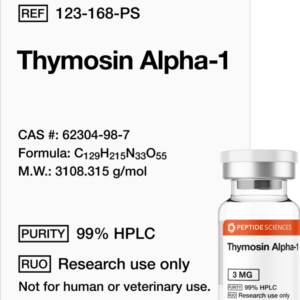
The Thymosin Alpha-1 listing displays 3mg and 10mg options. Researchers should select the variation required by their project and review the information applicable to that choice.
| Product information | Listing details |
|---|---|
| Named peptide | Thymosin Alpha-1 |
| Common research abbreviation | Tα1 |
| Listed quantity options | 3mg and 10mg |
| Molecular description in the literature | Peptide comprising 28 amino-acid residues |
| Catalogue category | Research Peptides |
| Supplied formulation | Review the applicable product specification |
| Intended purpose | Laboratory research |
The selected option identifies a stated quantity. It does not independently confirm purity, concentration, sterility, biological activity or the composition of any additional ingredients.
For Thymosin Alpha-1, retain the selected variation in purchasing records so later documents can be matched to the correct package. A general product title may remain the same while the amount supplied differs.
Before ordering, check the variation selector and resolve any inconsistency between the chosen option, label description and supporting documents. Use the product contact page when information essential to your laboratory assessment is unavailable.
Peptide Identity and Early Characterisation
The original isolation and sequence-analysis literature identifies Thymosin Alpha-1 as a peptide containing 28 amino-acid residues. This molecular description distinguishes the defined peptide from broader thymic extracts containing multiple components.
The foundational paper was published in 1977 and reported the isolation and characterisation of the substance from thymic material. Researchers can inspect the original isolation and sequence-analysis study for its historical and analytical context.
Historical origin and present-day product manufacture are separate questions. The way a peptide was first isolated does not establish the process used to produce a particular commercial preparation.
For Thymosin Alpha-1, the supplied material should therefore be assessed through its own specification and available identity documentation. A reference to the original discovery cannot substitute for evidence about a contemporary batch.
This distinction also helps researchers use terminology accurately. A defined peptide, the biological material from which it was first isolated and a formulated research product are related subjects, but they should not be described as though they were the same preparation.
Sequence Features and Structural Confirmation
Research on Thymosin Alpha-1 includes detailed sequence analysis and independent confirmation of its primary structure. These investigations provide a stronger basis for molecular identification than a catalogue name alone.
A 1979 sequence-analysis paper describes the peptide’s acetylated amino-terminal serine. A later investigation confirmed the primary structure using independent analytical procedures. Read the original sequence-analysis paper and the independent structural-confirmation study.
For laboratory purchasing, molecular details matter when a project depends on a particular preparation. Researchers should assess the identity stated in the product documentation rather than assuming that every similarly named material has been characterised in the same way.
Thymosin Alpha-1 documentation may need to address the peptide identity, relevant modifications and supplied chemical form, depending on the requirements of the work.
A publication establishes the structure of the molecule investigated by its authors. It does not independently establish the structure, amount or composition of the contents of a supplier’s package. Those questions require information connected to the actual material being considered.
Interpreting Milligrams and Research Quantities
Thymosin Alpha-1 is listed in milligram quantities. Three milligrams equals 3,000 micrograms, while ten milligrams equals 10,000 micrograms. These conversions can help researchers reconcile labels with inventory systems using different units.
The quantity should always remain attached to its scope. A stated amount of peptide is different from the complete package weight, which can include formulation components and packaging.
It is also different from a solution concentration. A mass expressed in milligrams does not describe milligrams per millilitre unless an applicable volume is also specified.
When recording Thymosin Alpha-1, keep the original label wording alongside any converted values. That makes the calculation traceable and helps another researcher confirm which variation was selected.
The larger option should not be described as more biologically effective simply because it contains a greater stated mass. Quantity selection depends on the material required by the project.
Neither listed option provides an administration regimen, treatment duration or personal-use recommendation. Experimental requirements must be determined through the laboratory’s own project planning and relevant procedures.
Dendritic-Cell Research and Innate Signalling
An original investigation of Thymosin Alpha-1 examined dendritic-cell responses in an antifungal research context. The study reported functional maturation and interleukin-12 production under the conditions investigated, with involvement of Toll-like receptor and MyD88-associated signalling.
This work is relevant to understanding why the peptide appears in research concerning communication between innate and adaptive immune responses. The experiment provides evidence about a particular model and set of measurements rather than a universal description of every possible immune effect.
Researchers can examine the original dendritic-cell and Toll-like receptor study for the reported methods and findings.
For Thymosin Alpha-1, this publication supplies a research rationale, not a guarantee that a catalogue preparation will reproduce the reported observations.
A careful summary should retain the experimental context and distinguish measured results from broader proposals about therapeutic use. The presence of a signalling pathway in a paper does not establish a complete mechanism across all tissues or conditions.
Researchers should also confirm that their intended material and model are appropriate for the question being investigated.
Immune Tolerance and Regulatory Responses
Thymosin Alpha-1 research is not limited to observations described as immune activation. An original investigation also examined dendritic-cell tryptophan metabolism and a regulatory environment involving inflammation and tolerance.
The publication discusses indoleamine 2,3-dioxygenase-associated processes within its experimental setting. It provides a useful counterpoint to descriptions that reduce the peptide’s research context to simply making every immune response stronger.
The original study on dendritic-cell tryptophan metabolism and tolerance allows readers to inspect this line of investigation directly.
A review of Thymosin Alpha-1 should therefore identify the specific response being measured. Activation, regulation and tolerance describe different questions, and their meaning depends on the model and endpoint.
These findings do not establish a general benefit for autoimmune disease, allergy or another condition. They also do not confirm the biological activity of a particular supplier’s batch.
For laboratory planning, the useful question is which observation or mechanism the proposed work can evaluate, rather than whether a broad promotional description sounds favourable.
Preclinical Research and Experimental Context
Another original study involving Thymosin Alpha-1 investigated intestinal inflammation associated with anti-CTLA-4 treatment in mice. The authors reported findings involving a regulatory pathway in the gut while examining antitumour responses within the same experimental setting.
This is a specialised preclinical investigation. Its relevance depends on the specific interventions, animals and outcomes studied. It should not be presented as a general demonstration that the peptide prevents treatment complications in people.
Researchers can inspect the original paper on intestinal immunopathology to review the evidence and its context.
When assessing Thymosin Alpha-1, retain the the distinction between an animal-model finding and an established clinical application. A proposed biological explanation may be valuable for further research while remaining insufficient to support a personal-use claim.
Studies with several simultaneous outcomes also require careful reading. Evidence about one measurement should not automatically be extended to every outcome discussed.
The role of this reference is to inform independent scientific review. It does not establish suitability of the research product for administration or clinical use.
What a Large Clinical Trial Found
A balanced review of Thymosin Alpha-1 should include findings that limit expectations as well as studies suggesting possible activity. A large phase 3 sepsis trial published in The BMJ in 2025 found no clear evidence of a reduction in its primary outcome of 28-day all-cause mortality.
The study randomly assigned 1,106 adults and analysed 1,089 in its modified intention-to-treat population. Mortality was 23.4% in the peptide group and 24.1% in the placebo group. The publication also has a linked correction.
Read the original TESTS trial and its linked correction when evaluating this clinical research ar”}}
This result matters because a plausible immune mechanism does not guarantee a measurable clinical benefit. The finding also cautions against selecting only favourable earlier reports.
For Thymosin Alpha-1, the trial does not establish that this supplier’s research preparation is suitable for treatment. Clinical study products and catalogue research materials require separate identification and documentation.
The evidence should be interpreted according to the question the trial actually tested.
Comparing Studies Without Combining Unlike Evidence
A literature review for Thymosin Alpha-1 should separate molecular characterisation, cell experiments, animal investigations and clinical trials. These study types answer different questions and should not be treated as interchangeable evidence.
A structural paper can establish molecular features. A cell experiment may identify a response under controlled conditions. A clinical trial evaluates defined outcomes in a particular population using a specified intervention.
When comparing publications, record the material, model, comparator and primary endpoint. If these differ substantially, explain the differences before drawing a combined conclusion.
For Thymosin Alpha-1, avoid turning several unrelated observations into a single claim of broad effectiveness. A result involving one pathway does not automatically establish an outcome in another research setting.
It is also useful to distinguish findings selected in advance from exploratory analyses. A suggestion that emerges from a subgroup may identify a question for further study rather than settle it.
Keep the original source with the research notes. This allows collaborators to inspect the evidence directly and prevents an abbreviated commercial summary from becoming the only record of what a study reported.
Defined Peptides and Thymic Complexes
Thymosin Alpha-1 should remain distinct from Thymalin and other thymic preparations when comparing products. A shared association with the thymus does not establish matching composition.
The published literature describes Thymalin as a peptide complex, whereas the peptide discussed on this page has a defined primary structure. These are different descriptions with different implications for material assessment. [See the original Thymalin research paper](https://pubmed.ncbi.nlm.nih.gov/33237528 “}}
Researchers can view the separate Thymalin product listing when comparing catalogue entries. The link is provided for identification and comparison, not as a recommendation to substitute one preparation for another.
For Thymosin Alpha-1, the relevant choice depends on the substance required by the proposed investigation. Similar names, shared research topics or matching quantities do not establish equivalence.
A project that specifies one defined peptide should not silently switch to an extract or mixture. Any proposed substitution needs to be assessed against the scientific purpose and documented before it influences interpretation.
Product Identity and Supporting Documentation
Before purchasing Thymosin Alpha-1, determine which aspects of the supplied preparation your laboratory needs to verify. A catalogue name, available quantity and research summary do not answer every identity question.
Useful documentation connects the substance named on the label with the material actually supplied. Researchers should examine the sample description and analytical scope instead of assuming that a familiar report format provides all necessary information.
A document may concern a starting ingredient, an intermediate material or the finished preparation. These are not automatically equivalent samples.
For Thymosin Alpha-1, the exact formulation and supplied chemical form may matter to a particular method. Ask for clarification when the available specification does not answer an essential question.
This description does not claim a verified manufacturing origin, independently confirmed identity or a particular certification for every package.
The Quality Control page is the website’s destination for quality information. If the details required for your project are absent, contact the supplier with a precise request before selecting the material.
Purity, Quantity and Biological Activity
Evaluating Thymosin Alpha-1 involves several distinct questions: whether the expected substance is present, how much is present, what else accompanies it and whether it behaves as required in a particular experiment.
A single analytical result does not necessarily resolve all of these questions. The meaning of a reported percentage or measurement depends on the method and the sample tested.
Researchers should identify the basis of any purity claim and determine whether it addresses the needs of their project. An identity result is not automatically a quantity measurement, and a quantity measurement does not establish a biological response.
For Thymosin Alpha-1, this page does not promise a particular purity percentage, activity level, sterility status or batch-specific result. Such claims require appropriate supporting evidence.
Set the project’s material requirements before reviewing documentation. This makes it easier to identify which questions have been answered and which remain unresolved.
Where a missing characteristic is essential to interpretation, resolve it before the material enters an experiment that depends on that characteristic. A broad assurance of quality should not replace a specific answer.
Recording Variations and Batch Information
Keep the selected Thymosin Alpha-1 variation connected with the order record, package label and any supporting documents. This is especially useful when a laboratory purchases more than one quantity option.
Record the stated amount exactly as supplied, together with the batch identifier where available. If an internal laboratory code is assigned, preserve its connection to the original package.
A later purchase should not automatically inherit analytical conclusions from an earlier package. Determine which records apply to each delivery and retain that distinction throughout the project.
For Thymosin Alpha-1, the scientific literature belongs with the research rationale, while supplier documents belong with the material record. Keeping these sources organised by purpose helps prevent one from being mistaken for the other.
If the specification changes, retain the version relevant to the material already received. A revised description may not retrospectively characterise an older package.
Use the contact page to resolve discrepancies, providing the exact variation, order reference and batch details where available.
Storage, Receipt and Laboratory Handling
Thymosin Alpha-1 should be handled according to information applicable to the actual supplied preparation and the laboratory’s established procedures. The name alone does not establish every storage or stability requirement.
Physical format, formulation and packaging should be considered together. Instructions taken from an unrelated product or a different preparation should not automatically be transferred to the material received.
Before ordering, determine whether the laboratory has sufficient handling information and suitable storage arrangements. Request clarification if essential conditions are missing.
For Thymosin Alpha-1, this description does not assign a universal shelf life, refrigeration schedule or stability period after laboratory preparation. Those details require appropriate product-specific evidence.
At receipt, compare the package with the order and note any visible damage, missing identifiers or inconsistent information. Keep the original label connected with subsequent internal records.
Appearance alone cannot confirm identity, amount or suitability. The laboratory’s acceptance procedures and applicable documentation should guide whether the preparation can be assigned to the intended work.
No personal reconstitution or administration instructions are provided here.
Planning a Focused Laboratory Investigation
A useful project involving Thymosin Alpha-1 begins with a defined question rather than a broad expectation of improved immunity. The question should identify what will be measured and how the result will be interpreted.
An investigation concerned with molecular identity needs different evidence from one concerned with a cellular response. The starting material, reference information and supporting documentation should fit that purpose.
Record what is known from the supplied specification and what remains an assumption. If the experiment depends on an unresolved formulation detail, address it before selecting the material.
For Thymosin Alpha-1, published methods can inform a research plan, but they are not automatically validated for a different supplier’s preparation or another laboratory setting.
Keep exploratory observations distinct from conclusions that the work was designed to support. This makes the result easier to assess and reduces the risk of presenting an interesting finding as a settled mechanism.
The material should be selected because it meets a documented experimental requirement, with limitations recorded clearly enough for another researcher to understand and review.
Ordering and Product Enquiries
Review Thymosin Alpha-1 through its existing product page. Check the displayed variations and select the stated quantity required by your laboratory.
Before ordering, confirm the number of packages, delivery address and available delivery arrangements. Complete any institutional purchasing requirements before relying on the material for scheduled work.
If a project depends on a specific document or preparation detail, resolve that question first. A general catalogue description is not a guarantee that a particular report, dispatch date or stock allocation will be available.
For enquiries about Thymosin Alpha-1, include the complete product name and selected variation. Explain whether the question concerns composition, packaging, documentation or an existing order.
Use the Peptide Lab Sciences contact page or email info@peptideslabsciences.co.uk.
This catalogue product is supplied for laboratory research. References to clinical investigations provide scientific context and do not establish this preparation as a medicine, supplement or material suitable for personal administration.
Frequently Asked Questions
1. What Is Thymosin Alpha-1?
It is a peptide comprising 28 amino-acid residues, investigated in molecular and immune-related research. The literature includes work on its structure, cellular responses and outcomes in defined clinical settings.
The supplied product still requires its own assessment. A publication describing the molecule does not independently confirm a commercial package’s identity, quantity, purity or formulation. Review the applicable specification and available documentation before selecting the material for a laboratory project.
2. Which Thymosin Alpha-1 Quantities Are Listed?
The retrieved product listing displays 3mg and 10mg variations. Check the current selector when ordering and retain the chosen option in your purchasing records.
These figures describe stated material quantities. They are not personal-use recommendations or evidence that one option is biologically more effective than the other. Select the amount according to the laboratory’s requirements, and resolve any conflict between the option selected and the package specification before relying on it.
3. Does Thymosin Alpha-1 Mean the Same Thing as Tα1?
Tα1 is a common abbreviation used for the peptide in research literature. Publications may also use typography such as “thymosin alpha 1” or “thymosin α1.”
When searching, these forms can help locate relevant sources. Nevertheless, always check the actual substance described in the paper. A similar name or a reference in the introduction does not establish that the investigators tested the preparation relevant to your work.
4. Is Thymosin Alpha-1 the Same as Thymalin?
No. The defined peptide and the thymic peptide complex discussed under the Thymalin name should be treated as different preparations.
Researchers should not transfer findings between them solely because both appear in immune-related literature. Use the exact substance name in purchasing and experimental records. If a project requires a defined peptide, a complex or extract should not be substituted without an assessment of whether it can answer the same research question.
5. Is Thymosin Alpha-1 a Proven General Immune Booster?
This listing does not establish a general immune-boosting benefit in people. The published evidence concerns specific models, responses and clinical questions.
A result involving one pathway or cellular measurement should not be expanded into a promise of better health, faster recovery or resistance to infection. Review the relevant original study and keep measured findings separate from hypotheses, exploratory results and broad commercial interpretations of the research.
6. Do Thymosin Alpha-1 Studies Verify This Product?
No. Scientific studies describe the materials investigated by their authors. They do not independently verify the preparation supplied through this catalogue.
Use original publications to understand the research background and product documentation to assess the material being purchased. Both sources are useful, but they answer different questions. A well-matched citation cannot replace evidence about the identity, quantity or other characteristics of a particular package.
7. Does Thymosin Alpha-1 Come With a Certificate of Analysis?
Check the listing and ask which documents are available for the selected preparation and batch. This description does not promise a particular certificate, analytical method or result.
Where a report is supplied, review the sample description, batch identifier and scope of the measurements. A report for another material or starting ingredient may not answer the questions your laboratory has about the finished preparation. Assess it against the actual requirements of the project.
8. How Should Thymosin Alpha-1 Be Stored?
Follow information applicable to the supplied format and the laboratory’s established procedures. If essential storage conditions are missing, request clarification before arranging receipt.
Do not automatically apply instructions from another peptide, another formulation or an unrelated source. This page does not provide an unsupported temperature, shelf life or post-preparation stability claim. Product-specific information and the laboratory’s assessment should guide those decisions.
9. Is Thymosin Alpha-1 Supplied for Human or Veterinary Use?
No. The material offered through this research catalogue is not supplied for human or veterinary administration, consumption, diagnosis or treatment.
The existence of clinical or animal studies does not change the intended use of this preparation. Those publications concern their own study materials and conditions. The stated product quantities should therefore be interpreted as laboratory supply information rather than a regimen for personal experimentation or medical use.
10. Where Can I Ask About Thymosin Alpha-1 Before Buying?
Use the contact page and provide the full product name with the variation you are considering. Identify whether the enquiry concerns formulation, packaging, available documentation or an existing order.
A precise question helps connect the enquiry with the correct preparation. Where a detail is essential to the proposed investigation, obtain clarification before purchasing rather than relying on information about another strength, batch or related peptide.
Explore Research Materials
Choose laboratory materials according to their documented identity, supplied format and relevance to the question being investigated. Use the original research linked above to examine the scientific background while assessing the actual preparation through its applicable product information.
Visit the complete research shop, compare peptide bioregulator listings, or contact Peptide Lab Sciences for product-specific enquiries.
For laboratory research only. Not for human or veterinary use, consumption, personal administration, diagnosis or treatment.
Reviews
There are no reviews yet.