Research capsule labels contain several different kinds of information: the named material, the amount claimed per unit, the number of units and sometimes an overall package total. A laboratory that fails to separate those quantities can misread a product listing even when the arithmetic appears simple. Capsule presentation also says very little about the chemical class or whether the preparation is suitable for a particular analytical technique.
This guide explains how to read laboratory capsule listings accurately, compare them with vials or powders and ask for the composition documents that matter. It does not give administration, self-experimentation or personal-use advice. Peptide Lab Sciences identifies its research-capsule products as laboratory materials not for consumption.
Understand the four quantities in one listing
Consider a hypothetical title reading “Compound A, 2 mg × 60 capsules”. The 2 mg figure may be a claimed amount of the named compound in each unit. The 60 identifies the stated unit count. Their product, 120 mg, is the implied total claimed amount of the named compound across the pack if the label is intended in that way. None of those values establishes the net mass of the filled capsule, the mass of the shell, the amount of any excipient, analytical purity or biological potency.
A concentration is also different from a mass declaration. It would need a suitable denominator such as volume. A capsule title specifying milligrams does not automatically provide a concentration that can be used in a research protocol.
The Research Capsules category gives real examples of different naming conventions, including per-unit quantities, package counts and compound names. Read the full selected product entry because a title may omit a significant formulation detail.
Format and chemical identity are independent
A capsule is a physical presentation, not a chemical classification. The category includes peptide-related compounds, small molecules and multi-component formulations. Finding two items under the same navigation heading does not mean they contain related substances or are intended for the same experimental model.
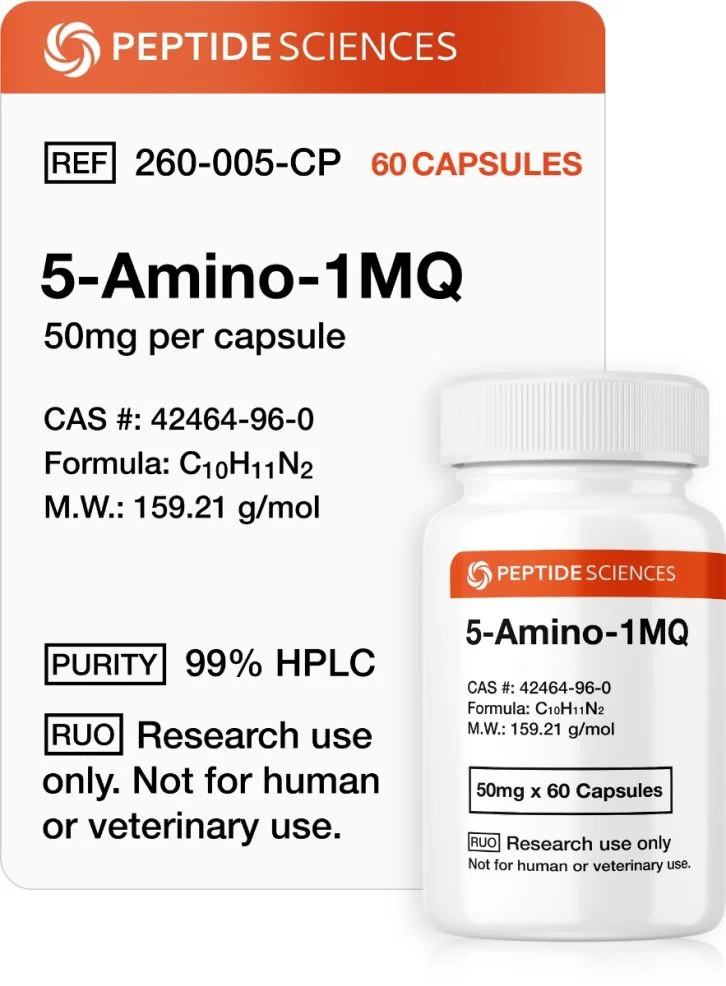
For example, GHK-Cu 2 mg × 60 capsules identifies a copper-associated tripeptide preparation, while 5-Amino-1MQ 50 mg (60 capsules) describes a small-molecule research compound rather than a peptide. The format is shared, but the relevant chemical identities and characterisation questions differ.
The Cellular and Metabolic Research category also arranges materials by a research theme, not a single class of molecules. Use formal identifiers when comparing the material with scientific literature.
Capsule fill, named compound and shell are separate
An encapsulated laboratory preparation can contain its named compound along with formulation ingredients. The capsule shell itself adds another physical component. The mass of the named compound is therefore not generally the mass of all contents and shell combined.
Some listings describe capsules as inert containers for transport or storage of dry research substances rather than dosage forms. That wording should be taken seriously and not converted into consumer supplementation advice. It also makes detailed formulation information important: a container designed for one handling purpose is not necessarily equivalent to a neat analytical reference powder.
If fillers, carriers or excipients are relevant to the project, request their identity and applicable quantities. A buyer should not infer that they are absent simply because the title lists one principal compound.
Example: calculate the labelled total carefully
| Fictional per-unit declaration | Unit count | Implied named-compound total |
|---|---|---|
| 2 mg | 60 | 120 mg |
| 5 mg | 30 | 150 mg |
| 500 micrograms | 30 | 15 mg |
Here are three fictional labels and their implied named-compound totals, assuming that each printed amount applies per capsule: 2 mg × 60 gives 120 mg; 5 mg × 30 gives 150 mg; and 500 micrograms × 30 gives 15,000 micrograms, or 15 mg. These are arithmetic interpretations, not experimentally verified findings.
If the title instead reads “30 capsules, 150 mg total”, it may communicate the aggregate total rather than a per-unit figure. The wording must be checked to decide whether a division is appropriate. Where a product supplies a blend, the aggregate mass might refer to multiple constituents. Do not divide it equally among them without a documented breakdown.
Unit conversion is simple, but a wrong assumption about what a number measures cannot be repaired by mathematically correct multiplication. Keep the original label, unit and interpretation together in procurement records.
Why capsules should not be assumed equivalent to vials
A vial-labelled product may contain a different formulation and packaging configuration from a capsule product carrying the same principal name. Moisture state, stabilisers, sample preparation requirements and other properties can affect analytical planning. The amount named in each listing is only one piece of the comparison.
If an experiment requires a defined preparation, formulate a complete materials specification. Switching from a neat substance to a multi-ingredient capsule preparation needs an explicit technical assessment. Likewise, buying a greater number of capsules does not automatically increase compatibility with a laboratory method.
Visit the Shop to inspect available formats, then check individual pages rather than treating visual similarity as chemical equivalence.
Review certificates for the correct material and stage
A certificate for an ingredient does not automatically verify a finished capsule preparation. The lab may need evidence for the starting material, the formulated preparation or both depending on the research question. An identity result also differs from a measured content result or a uniformity assessment.
When documentation is provided, read the name of the analysed sample and any batch identifier. Determine whether the results apply to the actual package being purchased, the raw compound before encapsulation or a different sample. A general report for a historical batch does not establish the characteristics of a new lot without additional evidence.
The site’s Quality Control section is a sensible location for supplier documentation, but an empty or generic page is not a substitute for the document itself. Request clarification before ordering when the analytical basis is essential to the work.
The BIPM table of SI prefixes supports the distinction between milli and micro used in these calculations. For a research example confirming that 5-amino-1MQ is discussed as a small-molecule inhibitor, see the original NNMT inhibitor study. That paper does not verify a supplier’s capsule formulation or establish suitability for human use.
For analytical context, USP’s historical harmonisation document on uniformity of dosage units distinguishes testing approaches involving individual-unit content and weight variation. It is cited as background, not as a current compliance specification or a statement that these research containers are medicines or certified dosage forms.
Watch for contradictions within a product page
Large catalogues can contain text from different editing stages. A summary may say the capsule is strictly a laboratory container while a longer section contains consumer wellness language. Those two descriptions cannot simply be reconciled by assuming the material has both uses. Clarify the intended product status and the current approved specification with the seller.
As part of a responsible SEO and product-content programme, research-only claims should remain consistent in the product introduction, extended description, FAQ and any linked blog post. Search visibility does not justify suggesting ingestion, treatment or dosing of a material supplied exclusively for research.
Record receipt information once the order arrives
When receiving a batch, compare the package count, label name, quantity statement and any batch reference with the original purchase order. Record any damage, missing item or discrepancy and keep the supplier communication attached to the material record.
If an approved protocol depends on a specific preparation, the responsible investigator should decide what information is needed before release for use. Do not silently substitute a package with a different unit count, composition or chemical form because its product nickname matches.
Keep storage information linked to the supplied format. Do not copy conditions from a different compound or presentation without checking the applicable documentation and laboratory procedures.
Frequently asked questions about research capsule labels
Does 2 mg × 60 mean 120 mg of the named compound?
It implies that total if the 2 mg statement truly applies to each of 60 units. It does not verify actual measured contents or total capsule fill weight.
Is 500 micrograms equivalent to 0.5 milligrams?
Yes as a mass conversion. The original label still needs to specify whether the number is per unit or a pack total.
Is a capsule-format research product an oral supplement?
No. Physical presentation does not create a consumer-use authorisation; the catalogue identifies these preparations as research-only materials.
Does an ingredient COA certify the entire finished capsule?
Not necessarily. Check which sample and manufacturing stage the document covers and which properties were tested.
Can two different capsule products be compared using price per pack?
Price per pack is only meaningful alongside the compound identity, unit quantity, content per unit, formulation and relevant documentation.
What should I do if per-unit content is unclear?
Ask the supplier to confirm the quantity basis and product specification before ordering. Do not infer it from a familiar catalogue naming pattern.
Read the exact named compound, the per-unit quantity, unit count and complete formulation as separate facts. Calculate totals only after their meaning is clear, and keep all research-only restrictions and batch records attached to the correct product.
Explore the Peptide Lab Sciences homepage for catalogue navigation. Technical references and linked specifications checked on 9 October 2026. Arithmetic examples are hypothetical and are not dosing advice.