A laboratory may encounter a named peptide as a standalone research material, as part of a multi-component mixture or in a coordinated set of separate containers. These are not automatically interchangeable purchasing choices. The distinction matters because peptide blends vs single peptides is a comparison with different composition, documentation and analytical requirements.
This guide sets out a practical method for comparing listings without making assumptions about compatibility, activity or suitability for personal use. It is intended for UK research purchasing and quality-control teams choosing materials for lawful experiments.
Start with the experimental question, not a product nickname
A purchasing brief should identify the substance or preparation required by a validated protocol. Product nicknames may be memorable, but they may not be precise chemical descriptions. A name such as “blend” or a commercial formulation title does not tell a researcher exactly how many substances are included, their molecular identities or their relative quantities.
The Peptide Lab Sciences research-peptides category lists individual research materials, while its peptide-blends category groups multi-component preparations and related sets. Those categories are navigation tools. The decisive source is the complete specification attached to a selected product or variation.
If the protocol names one defined molecule, verify that the purchased material corresponds to that molecule. If the experimental design specifically requires a defined mixture, determine whether the offered product reproduces the prescribed composition. A combination should not be chosen merely because it lists familiar ingredients.
Three different formats can look similar online
Single-component material: a product description identifies one principal peptide or molecule. It may still contain a specified counterion, residual solvent, water or other material; “single” is not a claim that the physical package contains nothing else.
Pre-formulated blend: two or more named components are supplied together in one preparation. Characterisation may need to address each relevant constituent as well as the properties of the overall formulation.
Coordinated research set: two or more separate containers are sold in one listing or package. Such a set is not necessarily a premixed formula. Inventory and test records may need to remain separate for each component and lot.
When comparing catalogue options, ask explicitly which of these three formats applies. The answer affects receiving checks, record-keeping and whether the product fulfils the laboratory’s approved specification.
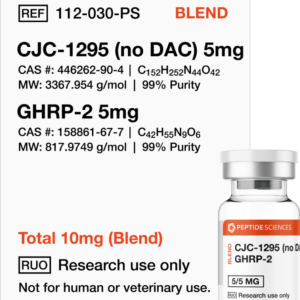
A total-mass label is not an ingredient-by-ingredient specification
| Format | What must be confirmed | Record structure |
|---|---|---|
| Single material | Complete identity and stated quantity | One material record plus batch documents |
| Premixed blend | Every constituent, ratio and total quantity | Formulated-batch record plus component evidence |
| Coordinated set | Contents of every separate container | Parent order linked to each container and lot |
Suppose a fictional research blend is advertised as “20 mg total”. This statement could describe two components at 10 mg each, a different ratio, or another arrangement entirely. It does not justify assuming 20 mg of every constituent. Likewise, a package containing several vials may quote a per-vial figure rather than the amount for the whole order.
A useful blend specification identifies every named component, its stated amount and the total amount for the selected preparation. If ratios are provided, examine whether they are expressed by mass, molar quantity or another relevant basis. Those approaches are not automatically equivalent because compounds can have different molecular masses.
For buyers comparing peptide blends for laboratory research, a simple comparison table can prevent misunderstandings before checkout. List the full constituent names, quantities, package count, physical format, available documents and unresolved questions for each candidate.
Chemical identity matters more than apparent similarity
Two product names can share a peptide family label while referring to modified, truncated or otherwise distinct materials. A sequence modification, conjugate, salt or fragment designation may matter to the experimental question. Do not remove such qualifiers when copying a product title into procurement records.
The same principle applies to materials listed in different catalogue families. A capsule-format preparation may carry fillers or other formulation components, while a vial-based product could have a different composition. Even if the named principal ingredient is similar, the two formats require separate evaluation.
The Research Capsules category illustrates why presentation deserves its own check: capsule count and quantity per capsule are different fields. Neither field describes an administration schedule, and research-only capsule products should not be assumed to be suitable for consumption.
How analytical documentation differs for blends
For a single-component material, a laboratory might seek methods addressing identity, relevant impurity profiles and stated quantity. A multi-component preparation may require additional consideration of whether every declared constituent has been distinguished and measured. A result reported for the combined sample does not necessarily characterise each component independently.
A chromatogram that shows several peaks cannot be interpreted from peak count alone. Different components can overlap, detector responses can differ and an appropriate method may need validation for the proposed composition. When a supplier states that a blend is “high purity”, ask what material was tested and what numerical claim actually describes.
The USP-hosted review of analytical approaches for synthetic peptides identifies multiple quality attributes and test methods. The ICH Q6B guidance hosted by the European Medicines Agency also distinguishes identity and purity as separate analytical attributes in its defined regulatory context. The WHO training materials on certificate-of-analysis records offer useful examples of batch traceability and reporting fields. Its discussion reinforces an important buying principle: identity, chromatographic purity and other aspects of characterisation do not collapse into one number.
Keep literature evidence separate from catalogue qualification
A paper investigating one of the components of a blend cannot establish the effects of the entire commercial mixture. Different concentrations, models, controls or chemical forms may produce different experimental observations. Literature is valuable for understanding the scientific context; the supplier’s batch records are needed for material qualification.
When reviewing a study, extract the exact compound identity, preparation, experimental model and endpoint. Then ask whether those details align with the material offered. If the information is not sufficient to support that comparison, mark it as a limitation rather than drawing a commercial conclusion.
This is especially important for terms circulating in online discussions about “recovery”, “performance”, “longevity” or other broad outcomes. Such language is not a substitute for a validated research model and should not be presented as evidence of therapeutic benefit in people.
Procurement and traceability for multi-component products
A useful receiving record connects the order number to every container, batch and supporting document. For a coordinated set, recording just the kit name can hide differences between the individual components. For a premixed product, the final formulated batch identifier may also be important.
Purchasers should determine whether a report applies to each individual input, the finished mixture or both. If the research protocol specifies certain impurity limits, they must be supported by appropriate evidence rather than inferred from unrelated tests. Clear lot tracking also makes future internal reviews more reliable.
The same considerations affect storage and handling. No single generic temperature or solvent statement covers all peptides and formulations. Use the current product information, laboratory safety procedures and approved methods. Avoid translating research-material descriptions into personal dosing or mixing instructions.
Compare value without oversimplifying the price
A low price per advertised milligram does not establish better value if the material has the wrong chemical form, incomplete composition data or missing documentation needed by the laboratory. Nor can two formulations be compared by mass alone when their constituents and preparation methods differ.
For a defensible purchasing comparison, start with the required specification. Eliminate products that do not meet it, then consider package size, supply format, traceability and total order requirements. Price comparisons become meaningful only after the alternatives are genuinely comparable.
This is where commercial category pages are most useful: they help a buyer locate potentially relevant options quickly, then move to an individual product page for the facts needed before an eligible research purchase. Browse the Peptide Lab Sciences shop and contact the supplier if a constituent amount or lot qualification is essential but unclear.
Questions to ask before purchasing a research peptide blend
- Is this one mixture or a set of separately packaged materials?
- What is the complete scientific name of every constituent?
- Does the headline quantity mean total mass, per-component mass or per-vial mass?
- Are ratios and any relevant counterions or modifications specified?
- What does each available report actually test, and which batch does it describe?
- Is the proposed use lawful and consistent with an approved laboratory protocol?
- What happens if the selected variation differs from the version used in the research documentation?
A written answer to these questions is more useful than a generic claim that one preparation is stronger or better than another.
Frequently asked questions
What is the difference between a peptide blend and a single peptide?
A single-peptide listing names one principal peptide, while a blend contains two or more stated components. A coordinated set may contain those components in separate containers.
Does a 20 mg blend contain 20 mg of each ingredient?
No. It may state the total mass of several constituents. Check the component-by-component specification before ordering.
Are blended research peptides automatically better for experiments?
No. Suitability depends on the specific research question, material identity and protocol. More ingredients do not demonstrate better performance or compatibility.
Can a certificate for one component validate the whole blend?
Not by itself. A component-specific result and a formulation-level result address different samples and may answer different questions.
Where can I compare available UK laboratory blends?
Use the Peptide Lab Sciences Peptide Blends category, then open the relevant individual listing to review its complete specification.
For a current catalogue example, see the CJC-1295 No DAC and GHRP-2 10 mg blend listing. Its inclusion here is for specification comparison, not a recommendation or claim of suitability.
Research-use notice: All comparisons here concern lawful analytical and laboratory research. Research-only peptide materials are not intended for human or veterinary consumption, injection, treatment or self-experimentation.