Testagen 20mg: A Clear, Helpful Bioregulator Research Guide
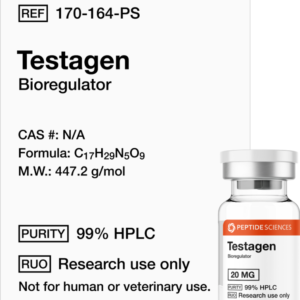
Testagen 20mg is listed by Peptide Lab Sciences within its laboratory research catalogue. This guide brings together the stated product quantity, relevant scientific terminology, original publications and practical considerations for researchers assessing the material.
A useful product assessment begins with the identity of the substance being offered. It then considers the supplied formulation, supporting documentation and requirements of the proposed work. A product name and quantity provide a starting point, but they do not answer every question about a research preparation.
The information below separates published observations from product specifications. Scientific papers describe the material and conditions investigated by their authors. Product documentation describes the preparation supplied by a seller. Researchers need to understand both when deciding whether a material is appropriate for their project.
Testagen 20mg is offered for laboratory investigation only. This page does not provide personal administration instructions or advertise benefits for hormone levels, fertility, ageing or any medical condition.
Explore the Peptide Lab Sciences research catalogue to compare available materials and formats.
Product Overview and Information to Review
The Testagen 20mg listing states a quantity of 20 milligrams. Researchers should read that quantity alongside the complete product specification and any documentation relevant to the supplied preparation.
| Information | Description |
|---|---|
| Catalogue name | Testagen |
| Stated quantity | 20 milligrams |
| Catalogue classification | Peptide bioregulator |
| Literature terminology | Testagen; KEDG; Lys-Glu-Asp-Gly |
| Supplied formulation | Confirm from product documentation |
| Batch-specific testing | Review available reports |
| Intended purpose | Laboratory research |
The literature terminology in this table describes the peptide discussed in scientific publications. It should not be treated as independent analytical confirmation of the contents of a particular package.
Before selecting Testagen 20mg, establish what the stated quantity covers and how the material is supplied. Physical format, additional ingredients, chemical form and batch identification may all be relevant to a laboratory assessment.
Where an essential specification is missing, ask for clarification before ordering. A clear answer at the purchasing stage is more useful than an assumption carried into subsequent experimental work.
Use the product contact page for questions about the exact preparation.
Understanding the KEDG Peptide Name
In the published literature relevant to Testagen 20mg, Testagen is identified as Lys-Glu-Asp-Gly. The corresponding one-letter sequence is KEDG. These names describe an ordered sequence of four amino-acid residues, making the molecule a tetrapeptide.
The sequence is stated explicitly in an original investigation of short peptides and their interactions with cellular and nucleic-acid systems. A separate chemistry study also identifies Testagen using this sequence. Read the cellular study and the independent peptide chemistry study.
Sequence notation is useful for finding research that may not use the commercial name in its title. Searching both the full sequence and the short identifier can reveal relevant publications that a name-only search misses.
For Testagen 20mg, the next step is connecting that literature identity with the supplied material. A catalogue label should be checked against a specification or suitable analytical documentation rather than assumed to establish the complete molecular identity.
Keep the original wording of the supplier’s specification in laboratory records so later comparisons remain traceable.
What the Bioregulator Label Means for Purchasing
Testagen 20mg appears under the bioregulator label in the catalogue. Researchers should treat that label as a way of organising products and describing their research context, rather than as a complete specification.
A category name does not establish the material’s purity, biological activity, manufacturing method or suitability for a particular experiment. Those questions require information about the individual preparation.
It also does not demonstrate a clinical outcome. Terms such as “bioregulator” should not be read as proof that a product normalises an organ, restores hormone production or corrects a physiological imbalance in people.
When evaluating Testagen 20mg, begin with the exact substance and the question your laboratory needs to answer. Then assess the format, quantity and supporting records against that requirement.
This approach remains useful when comparing several products carrying similar descriptive labels. Two materials in the same category may differ in sequence, formulation and experimental relevance.
The complete shop allows researchers to browse individual listings, while the contact page provides a route for resolving product-specific questions before a purchase.
Interpreting the Stated 20mg Quantity
Testagen 20mg expresses a mass. Twenty milligrams equals 20,000 micrograms or 0.020 grams. These conversions can help researchers maintain consistent purchasing and inventory records.
A mass is different from a concentration. The product title does not specify a solution volume, so it cannot by itself describe a concentration in milligrams per millilitre. It also does not establish how much material an experiment will require.
The stated amount should remain connected to its scope. Researchers need to know whether the specification refers to the named peptide, a formulated preparation or another defined quantity. The total package weight may include components beyond the substance of interest.
For Testagen 20mg, preserve the original unit and label description alongside any converted values. This makes the calculation easy for another researcher to check.
The quantity does not describe an administration regimen, treatment duration or number of personal uses. Laboratory requirements depend on the approved project and the work being performed.
If the package label and product specification use conflicting quantities, resolve that discrepancy before relying on either figure in experimental records.
Published Cellular and Nucleic-Acid Research
An original study relevant to Testagen 20mg examined several short peptides, including Testagen, in fluorescence-based experiments. The investigators reported fluorescence in cellular compartments after exposure of HeLa cells to labelled peptides and investigated interactions with nucleic-acid systems.
These observations provide a specific experimental context for discussion of short-peptide localisation and molecular interactions. They should not be expanded into a claim that an unlabelled commercial preparation has demonstrated the same behaviour under every condition.
The distinction between labelled and unlabelled material matters when reading the paper. The measurement concerns the experimental preparation and detection method used by the investigators.
Researchers reviewing Testagen 20mg can follow the original publication on labelled peptides and DNA interactions to examine the reported methods and conclusions.
A cellular observation does not establish a clinical benefit. It also does not independently prove a complete mechanism of action for an entire organism.
When recording this reference, describe what was measured and avoid replacing a limited experimental finding with a broader statement about rejuvenation, hormone restoration or therapeutic effectiveness.
Thyroid Research in an Experimental Avian Model
The literature associated with Testagen 20mg includes work on Lys-Glu-Asp-Gly and another tetrapeptide in chickens following removal of the pituitary gland. This is a specialised experimental model rather than an investigation in healthy human volunteers.
A published study reported changes in thyroid-related hormone measurements and thyroid structure following investigation of the peptides in that model. The findings are relevant to the research history of the sequence, but their interpretation depends on the animals and experimental circumstances involved.
Researchers can inspect the original study of tetrapeptides and thyroid structure for the specific evidence.
For Testagen 20mg, this paper should be presented as preclinical background. It does not establish a treatment for thyroid disease, a personal hormone-management strategy or a verified effect of the supplied product.
The study also involves more than one peptide. A careful reading should determine which observations belong to each experimental group instead of attributing every finding to one compound.
This distinction supports a more accurate literature review and avoids turning a research association into an unsupported product claim.
Age and Model Differences in Published Investigations
Another publication relevant to Testagen 20mg compared thyroid-related findings in young chickens and older hens. The authors reported that the effects observed in the older animals were less pronounced than those described in the younger group.
That difference illustrates why age and model characteristics belong in a research summary. Reporting an outcome without the circumstances that influenced it can make the evidence appear more general than it is.
The original paper comparing young chickens and older hens provides the relevant publication record.
A review for Testagen 20mg should preserve distinctions between experimental populations. It should not assume that a finding in one age group transfers unchanged to another species, a different physiological state or an unrelated preparation.
For laboratory planning, this means identifying the model that actually addresses the proposed question. The purpose of a reference is to inform that decision, not to guarantee an outcome.
Differences between studies can be informative. They may identify limits, unresolved questions or conditions that deserve closer examination before a hypothesis is taken forward.
Other Outcomes Investigated in Preclinical Research
Testagen 20mg may also be encountered when reviewing publications that examine several outcomes within the same experimental system. One original avian investigation considered thyroid morphology alongside immune and haemostatic measurements.
The publication describes work with Lys-Glu-Asp-Gly and Ala-Glu-Asp-Gly in birds following pituitary removal. It should therefore be interpreted within that combined context of peptide identity, model and measured outcomes.
Researchers can consult the original paper on thyroid, immune and haemostatic parameters to inspect the source directly.
This research does not establish that Testagen 20mg improves immunity, prevents bleeding problems or provides another medical benefit. A list of endpoints examined in an experiment is not a list of established applications for a catalogue product.
When reviewing a paper with several measurements, record the findings separately. A change in one parameter does not automatically establish a change in another.
The relationship between an experimental observation and its broader biological meaning also needs to be explained by evidence, rather than inferred from a product’s descriptive name.
Building a Focused Literature Review
A literature review for Testagen 20mg should begin with a defined question. A project concerned with molecular identity needs different references from one examining a specific cellular observation.
Search using the substance name and sequence terminology, then check the actual material investigated in each publication. An article may discuss several peptides, cite earlier work or report findings from a different formulation.
Useful details to record include the publication year, experimental model, sample characteristics, endpoints and limitations. Keep the article’s persistent identifier with those notes so another researcher can return to the source.
For Testagen 20mg, separate original studies from reviews and commercial summaries. An original investigation reports its own methods and observations. A review organises existing findings, while a sales page may provide only a selective interpretation.
A short list of accurately matched references is more useful than a long list of loosely related publications. Each citation should answer a clear question or support a specific statement.
The linked papers in this guide are starting points. They do not replace a project-specific search or independent appraisal of the complete evidence available.
Connecting the Literature With the Supplied Material
A key question for Testagen 20mg is whether the supplied preparation matches the identity needed for the proposed work. A defined synthetic peptide and a tissue-derived mixture are different descriptions and should not be used interchangeably.
The literature’s use of a particular peptide name does not establish how a seller manufactured, formulated or packaged its product. Those are product-specific facts that require product-specific information.
Researchers should ask for a clear description of the preparation, including its stated identity and any additional components. If the documentation describes an extract, determine what has been characterised and how that information relates to the intended investigation.
For Testagen 20mg, do not substitute a published sequence for missing supplier documentation. Equally, do not infer tissue origin from the product name.
This distinction helps keep scientific claims and purchasing decisions aligned. It also makes later analytical results easier to interpret because the starting assumptions are recorded.
If the supplied specification contains conflicting descriptions, request clarification through the Peptide Lab Sciences contact page before selecting the material for work that depends on a defined composition.
Identity, Purity and Quantity Are Different Questions
Assessing Testagen 20mg may involve several separate questions: what is present, how much is present and what other components accompany it. One analytical result does not necessarily answer all of them.
An identity assessment concerns the substance being measured. A quantity assessment concerns the amount attributed to that substance. A purity statement requires a defined basis and method to explain what the reported percentage represents.
Researchers should read the scope of an analytical report before deciding how to use its results. A document may concern an ingredient, an intermediate preparation or a finished product, and those are not automatically equivalent samples.
For Testagen 20mg, this description does not claim a particular purity percentage, independent test result or manufacturing certification. Such claims need supporting documentation tied to the material supplied.
Determine in advance which characteristics your experiment depends on. Then compare those requirements with the information available.
Visit the Quality Control page for the website’s quality-information destination, and request any essential product-specific details that are not displayed.
Batch Documentation and Research Records
A purchasing review for Testagen 20mg should connect the product listing, package label and available reports to the same preparation. Consistent identifiers make it easier to investigate discrepancies and interpret later results.
Where a certificate of analysis is available, check the compound name, batch identifier, sample description and methods. Read the reported results within the stated scope of the document.
The title “certificate of analysis” does not by itself establish that a report covers the finished package or every attribute required by your laboratory. A document for a different batch should not be treated as a measurement of the material being considered.
For Testagen 20mg, keep copies of the applicable specification and records with the laboratory’s purchasing information. This allows subsequent work to be traced to the information available when the material was selected.
If a specification is revised, retain the distinction between the earlier and later versions. Clear records help prevent a new description from being applied retrospectively to an older package.
Product documentation questions can be directed to the contact page.
Physical Format, Storage and Handling Information
Testagen 20mg should be assessed in the physical format actually supplied. A product name and mass alone do not establish whether the preparation is a powder, solution, capsule or another format.
Storage and handling information should apply to that preparation and its packaging. Instructions taken from an unrelated product may not be suitable, even where both materials are described broadly as research peptides.
Researchers should review the applicable specification and their laboratory’s established procedures before receipt. Where essential conditions are missing, request clarification rather than assigning an unsupported temperature or shelf life.
For Testagen 20mg, this guide does not provide a universal stability period, reconstitution method or storage schedule. Those details require appropriate product information and a method suited to the planned laboratory work.
On arrival, compare the package with the order record and note any visible damage or inconsistent labelling. Preserve the connection between the original package and the laboratory’s internal identifier.
This approach supports traceability without assuming that appearance alone establishes identity, composition or suitability for use.
Comparing Other Research Products
Testagen 20mg can be reviewed alongside other catalogue materials, but a useful comparison needs a clear scientific purpose. Products should not be treated as substitutes solely because they share a category or stated mass.
Start with the identity required by the project. Then compare the supplied format, quantity, supporting information and any formulation details relevant to the work.
A 20mg listing for a different peptide may involve a different sequence and research context. The matching number does not establish comparable activity or equivalent experimental requirements.
When comparing Testagen 20mg with other materials, distinguish product selection from literature comparison. Two compounds can appear in the same paper without being interchangeable in a new experiment.
Browse the complete laboratory catalogue to inspect individual listings. Open each relevant page and assess its own specification rather than relying on category summaries.
The aim is to identify a preparation that meets a defined requirement. A clear comparison explains why a particular material is relevant and what evidence is still needed before that decision can be considered complete.
Planning a Suitable Laboratory Investigation
Before purchasing Testagen 20mg, define what the proposed investigation needs to determine. A focused question makes it easier to identify the necessary material specification, documentation and measurements.
Record which characteristics are known from the supplier’s information and which remain assumptions. If the work depends on a particular sequence or formulation, that requirement should be resolved before the material is selected.
The literature can help identify relevant questions and limitations, but it does not automatically provide a validated method for the supplied preparation. Researchers need to assess the applicability of the published work to their own setting.
For Testagen 20mg, keep exploratory observations separate from conclusions about mechanism or practical application. The scope of a conclusion should match the scope of the evidence collected.
A useful project record also states what a result would not establish. For example, an identity measurement does not demonstrate a therapeutic effect.
This page offers product and literature context. Experimental design, method selection and interpretation remain the responsibility of the qualified laboratory carrying out the work.
Ordering and Product Support
Review Testagen 20mg through its existing product page before placing an order. Confirm that the stated preparation and available information meet your laboratory’s requirements.
Check the selected item, number of packages, delivery address and available delivery arrangements. Complete any institutional purchasing requirements before relying on the material for scheduled work.
A product description should not be treated as a guarantee of a specific dispatch time, delivery period or stock allocation. Review the arrangements shown during ordering and ask about any timing that is essential to the project.
For questions about Testagen 20mg, include the full product name and identify the specification or documentation point that needs clarification. Where an order already exists, provide its reference so the enquiry can be matched to the correct purchase.
Use the contact page or email info@peptideslabsciences.co.uk for legitimate product and order enquiries.
Support questions should concern the material supplied and available information, rather than personal dosing or treatment advice.
Responsible Interpretation and Research Use
Testagen 20mg is supplied within this catalogue for laboratory research. The scientific references above describe experimental work and should not be interpreted as approval for personal administration.
Claims about testosterone production, fertility, thyroid treatment or rejuvenation require evidence directly addressing those outcomes in the relevant setting. A product name, a peptide category or a finding from an animal model cannot independently establish such claims.
Researchers should also distinguish a proposed mechanism from a demonstrated one. A plausible explanation can guide further investigation while remaining an unresolved hypothesis.
For Testagen 20mg, the appropriate purchasing decision depends on the specified preparation, available documentation and intended laboratory question. The page does not promise that a particular experimental outcome will occur.
Customers are responsible for ensuring that their purchase and intended work meet applicable institutional and legal requirements. Materials should remain within the laboratory context for which they are supplied.
Not for human or veterinary use, consumption, personal administration, diagnosis or treatment. No personal dosing or administration instructions are provided.
Frequently Asked Questions
1. What Is Testagen 20mg?
It is a catalogue listing with a stated quantity of 20 milligrams, offered for laboratory research. Publications using the Testagen name identify a particular short peptide, but researchers should confirm the identity and formulation of the supplied preparation through product documentation.
The listing name is a starting point for assessment. It does not independently establish the contents of a package, the manufacturing method or the analytical characteristics of a batch.
2. What Does KEDG Mean When Reviewing Testagen 20mg?
KEDG is the one-letter notation used for the peptide sequence Lys-Glu-Asp-Gly. Sequence terminology can help researchers locate papers that do not use the Testagen name in their titles.
When using these terms in purchasing or laboratory records, distinguish the identity described in a publication from the identity stated for the supplied material. The connection between them should be supported by the applicable specification rather than assumed from a catalogue label.
3. Is Testagen 20mg Necessarily a Tissue Extract?
The name alone does not establish tissue origin. A defined peptide and an extract containing multiple substances are different kinds of preparation.
Researchers should request a clear product specification explaining what is supplied. If the description refers to an extract, ask what components have been characterised. If it refers to a defined peptide, review the information supporting that identity. Conflicting descriptions should be clarified before the material is selected for a project.
4. Does Testagen 20mg Describe a Dose?
No. In this listing, 20mg is a stated material quantity. It does not provide a personal administration instruction or identify a treatment schedule.
It also does not describe a solution concentration without additional information about volume. Laboratory requirements depend on the planned work and relevant procedures. Record the quantity with its unit and scope so that the amount supplied is not confused with a concentration or an experimental requirement.
5. Can Testagen 20mg Be Advertised as a Testosterone Booster?
This research listing does not establish a testosterone-boosting effect in people. The references discussed above concern specific experimental questions and models, rather than proof of that commercial claim.
A connection with endocrine research should not be expanded into a promise about personal hormone levels or fertility. Product descriptions should reflect what the cited evidence actually supports and clearly distinguish research background from an established human outcome.
6. Do the Linked Studies Test Testagen 20mg From This Supplier?
The publications describe the materials used by their own investigators. They do not independently verify the preparation sold through this listing.
Use scientific papers to understand the research context. Use supplier specifications and relevant analytical records to assess the product being purchased. Both kinds of information can be useful, but they answer different questions and should not be treated as substitutes for one another.
7. Does Testagen 20mg Include a Certificate of Analysis?
Check the product page and ask what documentation is available for the relevant material and batch. This description does not promise a particular certificate or testing result.
Where a report is supplied, confirm its sample description, batch identifier and analytical scope. A report for a different preparation or starting ingredient may not answer the questions your laboratory has about the finished product. Assess the document against the requirements of the proposed work.
8. How Should Testagen 20mg Be Stored?
Follow information applicable to the actual supplied preparation and the laboratory’s established procedures. If essential conditions are not provided, request clarification before arranging storage.
Do not automatically transfer storage advice from another peptide or physical format. This page does not assign an unsupported refrigeration temperature, stability period or shelf life. Relevant product information should guide those decisions, together with the requirements of the laboratory responsible for the material.
9. Is Testagen 20mg Suitable for Human or Veterinary Use?
No. This catalogue listing is supplied for laboratory research and is not offered for human or veterinary administration, consumption, diagnosis or treatment.
Published experimental studies are included as background for qualified researchers. Their inclusion does not change the intended use of the product or provide permission for self-experimentation. The stated quantity and research terminology should therefore be read as product information rather than personal-use guidance.
10. How Can I Ask About Testagen 20mg Before Ordering?
Use the Peptide Lab Sciences contact page and include the exact product name with your question. Specify whether the enquiry concerns identity, formulation, available documentation, packaging or an existing order.
A precise enquiry helps connect the question with the correct preparation. Where information is essential to the project, obtain clarification before purchasing rather than relying on a description of another product or an assumption drawn from the research literature.
Browse Laboratory Research Materials
Review the product specification and available documentation against the needs of your laboratory. Use the linked original publications to examine the scientific background, while keeping their findings separate from claims about the supplied preparation.
Visit the research shop to explore the wider catalogue, or contact Peptide Lab Sciences for product-specific information.
For laboratory research only. Not for human or veterinary use, consumption, personal administration, diagnosis or treatment.
Reviews
There are no reviews yet.