Tesofensine 500mcg: A Clear, Helpful Research Guide
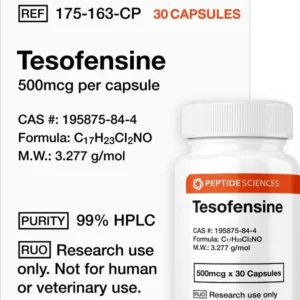
Tesofensine 500mcg is offered in a 30-capsule format for laboratory research. This page brings together the stated package information, relevant scientific literature and practical questions researchers should consider when assessing the material for a proposed project.
The product belongs to the broader catalogue of laboratory compounds supplied by Peptide Lab Sciences. Its capsule format is a packaging characteristic, while its chemical identity determines the scientific literature and analytical questions relevant to the material. Researchers should evaluate both before purchasing.
This guide explains how to interpret the named compound, distinguish per-capsule content from total package content, assess published studies and identify documentation needed for laboratory decisions. It also explains why a research publication about a compound does not independently verify a particular supplier’s preparation.
Tesofensine 500mcg is supplied for laboratory investigation only. The information below does not provide personal dosing instructions, establish therapeutic suitability or describe a course of treatment.
Browse our complete research catalogue to compare available materials and formats.
Product Overview and Stated Package Content
The Tesofensine 500mcg listing identifies the named compound, the stated content of each capsule and the number of capsules supplied. These details provide a starting point for purchasing and inventory records.
| Product attribute | Stated information |
|---|---|
| Named compound | Tesofensine |
| Content per capsule | 500 micrograms |
| Equivalent per-capsule mass | 0.5 milligrams |
| Package quantity | 30 capsules |
| Calculated total compound content | 15 milligrams |
| Supplied format | Capsules |
| Intended use | Laboratory research |
The calculated total describes the named compound based on the label claim. It does not establish the total weight of the capsule shells, fillers or complete packaged contents. It is also not a substitute for an analytical measurement of the supplied material.
For Tesofensine 500mcg, a complete assessment may require information beyond the product title, including the chemical form, additional ingredients and available batch records. Where an essential detail is missing, request clarification before choosing the material.
The Research Capsules category provides a place to compare other capsule-format listings without assuming that they share the same composition.
Understanding Micrograms, Milligrams and Package Totals
Tesofensine 500mcg uses micrograms to express the stated quantity per capsule. There are 1,000 micrograms in one milligram, so 500 micrograms equals 0.5 milligrams. Multiplying that amount by 30 capsules gives a total stated compound content of 15 milligrams.
These conversions help researchers maintain consistent inventory records. A purchasing system may use milligrams, while a product label uses micrograms. Recording both can reduce transcription mistakes and make comparisons between documents easier.
The quantity should always remain attached to its unit and scope. “0.5mg per capsule” and “15mg per package” describe different levels of the same listing. Neither expression describes the concentration of a laboratory solution, because no solution volume is specified.
When documenting Tesofensine 500mcg, preserve the original label wording alongside any converted value. This makes the calculation traceable and allows another researcher to check how the package total was obtained.
A 30-capsule package also does not establish how long a research project will last. Sample requirements depend on the approved study design and analytical work involved.
Chemical Identity and Research Classification
Tesofensine 500mcg should be assessed as a non-peptide research material. Tesofensine is discussed in the scientific literature as a small-molecule monoamine reuptake inhibitor, including under the development identifier NS2330. Its appearance on a peptide supplier’s website does not make it a peptide.
The distinction matters when searching for references. A paper about peptide synthesis, growth-hormone signalling or a similarly named compound may have no direct relevance to tesofensine. Literature selection should begin with the exact substance and the scientific question being investigated.
An early original investigation used NS2330 in its title and evaluated the compound in Parkinson’s disease research. The publication helps connect that development identifier with the tesofensine name used in later literature. Read the original NS2330 study.
For Tesofensine 500mcg, chemical identity must also be connected to the actual supplied preparation. A publication establishes what its investigators studied; product documentation establishes what a supplier states is present in a particular package.
Monoamine Transporter Research
Tesofensine 500mcg is relevant to literature concerning dopamine, noradrenaline and serotonin uptake. Published investigations describe tesofensine as inhibiting the presynaptic reuptake of these three monoamines. This is the basis for the term “triple monoamine reuptake inhibitor.”
That classification identifies a pharmacological mechanism. It does not mean that every downstream effect is understood, that all three transporters respond identically, or that a particular experimental outcome can be predicted from the compound name alone.
Researchers reviewing this subject can begin with the original study of tesofensine, energy metabolism and appetite, which discusses its monoamine reuptake profile in the context of a controlled investigation.
An evaluation of Tesofensine 500mcg should separate the mechanism described in the literature from any unverified assumptions about the supplied capsules. A catalogue description does not demonstrate transporter activity in the contents of a particular batch.
For a laboratory project, the relevant question is whether the material and its supporting information meet the requirements of the intended investigation. Broad pharmacological terminology cannot answer that question by itself.
Dopamine Transporter Imaging Research
Tesofensine 500mcg can be considered alongside published research into target engagement, while keeping the limits of that evidence clear. A PET investigation by Appel and colleagues examined dopamine transporter occupancy in relation to tesofensine exposure.
The researchers reported a relationship between exposure and transporter occupancy under the conditions studied. This provides a more specific type of evidence than simply identifying the compound as a reuptake inhibitor. It addresses whether a particular molecular target was engaged in that investigation.
The correct reference is the paper published in European Neuropsychopharmacology in 2014, with an earlier online publication date in 2013. Read the dopamine transporter PET study.
These findings do not establish transporter occupancy for Tesofensine 500mcg supplied through this catalogue. The commercial preparation, batch identity and experimental circumstances would need their own assessment.
When reviewing imaging research, distinguish the measurement made from the broader conclusions being discussed. Demonstrating target engagement does not, on its own, demonstrate a clinical benefit or establish suitability for personal administration.
Metabolic Research and Clinical Literature
Tesofensine 500mcg appears within a wider field of interest in metabolic regulation. One frequently cited original publication is the randomised, double-blind, placebo-controlled investigation by Astrup and colleagues published in The Lancet in 2008.
That study evaluated bodyweight, body composition and quality-of-life outcomes in participants with obesity. It is a source for understanding the compound’s research history, rather than evidence that the preparation sold on this page has been tested in the same way. Read the original Astrup trial.
When reading clinical literature, consider the population, comparator, study duration, formulation and endpoints together. A result belongs to the study conditions that produced it. A product description should not detach an attractive finding from those conditions and present it as a general promise.
Tesofensine 500mcg is therefore described here through its research context and stated specification. This listing does not promise weight reduction, appetite control, improved body composition or any other personal outcome.
For related catalogue browsing, visit Cellular and Metabolic Research.
Reading Neurological Findings in Context
Tesofensine 500mcg should not be described solely through favourable findings selected from the literature. Its research history also includes investigations that did not establish the hoped-for clinical benefit.
In an early Parkinson’s disease trial, the investigators reported that the tested regimens did not produce a significantly greater benefit than placebo at the main assessment point. That result is part of the evidence base and should remain visible when discussing the compound’s development. Read the early Parkinson’s disease trial.
For researchers, this illustrates why a plausible mechanism and an observed clinical benefit are separate questions. The presence of a molecular interaction does not settle the outcome of a complex investigation.
A literature review for Tesofensine 500mcg should record findings that support, limit or challenge the proposed research rationale. Keeping those distinctions explicit makes the review more useful for planning and interpretation.
The purpose of citing research is to help readers inspect the evidence. It is not to imply that every application discussed in a paper is an established use for the material offered here.
Selecting Relevant Scientific References
A useful literature review for Tesofensine 500mcg begins with the exact compound and a defined question. Searching only for broad phrases such as “metabolic benefits” can return papers about unrelated substances or outcomes.
Record the publication title, authors, journal, year and persistent identifier. Check that the linked record matches the citation, particularly where older website text has been copied between product pages. A correct author name with the wrong journal or year can still lead a reader to the wrong evidence.
It is also helpful to distinguish an original experiment from a review, commentary or commercial summary. These publication types serve different purposes. An original study provides its own methods and results, while a review interprets work conducted elsewhere.
When assessing Tesofensine 500mcg, ask whether the reference concerns the same compound, a combination containing it, or a different preparation. Similar terminology is not sufficient to establish equivalence.
The papers linked throughout this description are starting points for independent review. They do not replace a project-specific literature search or establish the identity and characteristics of the supplied capsules.
Capsule Format and Complete Formulation
Tesofensine 500mcg is supplied in capsules, so researchers need to consider the complete preparation when assessing analytical suitability. The named compound is only one part of the information required to characterise a capsule-format material.
Relevant formulation details may include the capsule shell, fillers, processing ingredients and the chemical form in which the compound is supplied. The title alone does not establish whether any particular ingredient is present or absent.
A laboratory method designed for a neat reference substance may not automatically suit a formulated preparation. Researchers should assess the material against the scope of their method and the information available about its composition.
For Tesofensine 500mcg, avoid assuming that the complete capsule contents weigh 500 micrograms. The stated quantity refers to the named compound, not necessarily the total filled mass.
The capsule format also does not establish analytical inertness. Whether a shell or additional ingredient affects a measurement depends on the material and method involved.
Use the product enquiry page to request composition information that is essential to your intended laboratory assessment.
Label Claims and Analytical Measurements
Tesofensine 500mcg has a stated per-capsule content, but a label claim and an analytical result serve different purposes. The label identifies the quantity being offered. An analytical report describes a measurement performed on a defined sample using a particular method.
When reviewing a report, identify exactly what was tested. Documentation for a starting ingredient may not characterise a finished capsule preparation. A measurement made on a pooled sample may answer a different question from measurements made on individual units.
These distinctions help researchers avoid treating one result as proof of every product attribute. Identity, amount, composition and variation across units are related questions, but they are not interchangeable.
For Tesofensine 500mcg, documentation should be interpreted according to its stated scope. If a report does not describe the finished preparation, do not assume that it does.
Researchers can establish in advance which measurements their project requires and then compare those needs with the available information. Where the required evidence is absent, that limitation should be resolved before committing the material to an experiment that depends on it.
Batch Documentation and Traceability
A review of Tesofensine 500mcg should connect the product listing, package label and available documentation to the same material. Consistent identification makes it easier to investigate discrepancies and understand which records apply to a particular delivery.
Where a certificate of analysis is available, examine the compound name, batch identifier, sample description, methods and reported results. Check whether the report covers an ingredient, the prepared capsule contents or another sample type.
The presence of a certificate title alone does not answer those questions. Likewise, a report for another batch cannot automatically establish the characteristics of the package being considered.
For Tesofensine 500mcg, ask what documentation is available rather than assuming a particular test, purity level or certification. This description does not make a batch-specific purity or independent-testing claim.
The website’s Quality Control page is the internal destination for quality information. If the details needed for your project are not displayed, contact Peptide Lab Sciences with the exact product name and the information required.
Comparing Research Materials by Purpose
Tesofensine 500mcg should be compared with other materials according to the question being investigated. Products grouped under metabolic research may differ substantially in chemical identity, biological context and supplied format.
A useful comparison begins with the required compound and the purpose of the work. It then considers the stated quantity, complete composition, documentation and compatibility with the planned assessment. Price and package size become meaningful only after these requirements are understood.
The Cellular and Metabolic Research catalogue provides an overview of related listings. Inclusion in that category does not mean that the products are substitutes or that their findings can be combined.
When comparing Tesofensine 500mcg with another capsule-format listing, keep compound identity separate from packaging. Two products containing 30 capsules may supply entirely different materials and quantities.
Similarly, a research peptide and a non-peptide compound should not be treated as equivalent because both appear in discussions of metabolism. The strongest comparison is one that explains how each material relates to a defined experimental requirement.
Planning a Laboratory Assessment
Before selecting Tesofensine 500mcg, establish what the proposed laboratory work needs to determine. A project investigating identity requires different evidence from one assessing formulation composition or evaluating a measurement method.
Define the question in terms that can be answered by the planned work. Identify the material specification, reference information and controls needed to interpret the result. This helps prevent a broad research interest from becoming an experiment with an unclear endpoint.
Document which characteristics are supplied as label claims and which are supported by measurements. Keep unresolved assumptions visible so they can be addressed before they influence interpretation.
For Tesofensine 500mcg, formulation details may be especially relevant when the planned method was originally developed using another physical format. Suitability should be established within the laboratory’s procedures rather than inferred from the compound name.
This page provides background and purchasing information, not a validated experimental protocol. Researchers remain responsible for determining whether the supplied preparation can answer their particular question and whether the available documentation is sufficient for that decision.
Storage, Receipt and Laboratory Handling
Tesofensine 500mcg should be handled according to the applicable product information and the laboratory’s established procedures. Storage conditions need to relate to the supplied preparation, its packaging and any supporting stability information.
A general instruction taken from an unrelated peptide page is not a sound basis for storing this material. Likewise, a condition reported for a different formulation should not automatically be transferred to the capsule preparation.
At receipt, compare the package label with the order record. Check the compound name, stated quantity, capsule count and batch information where present. Record any discrepancy or visible packaging problem before the material enters routine laboratory inventory.
For Tesofensine 500mcg, request clarification if storage or handling information needed by your laboratory is unavailable. This description does not assign an unsupported shelf life or universal refrigeration requirement.
Maintain the connection between the original package and any internal laboratory identifier. Clear records help ensure that later observations, enquiries and analytical results can be traced back to the material actually received.
Ordering and Product Enquiries
Tesofensine 500mcg can be reviewed through its existing product listing. Before ordering, compare the stated specification with the requirements of your laboratory project.
Check the selected product, number of packages and delivery details. If your institution requires particular documentation or purchasing approval, complete those steps before relying on the material for scheduled work.
Delivery arrangements and available services should be reviewed during the ordering process. A catalogue description should not be treated as a guarantee of a particular dispatch date, delivery period or stock allocation.
For questions about Tesofensine 500mcg, include the complete product name and explain the specification or documentation point that needs clarification. Where an order already exists, include the order reference so the enquiry can be connected with the correct purchase.
Use the contact page or email info@peptideslabsciences.co.uk. Product enquiries can address identity, packaging, available documentation and order details without turning the listing into personal administration guidance.
Research Use and Evidence Boundaries
Tesofensine 500mcg is offered within this catalogue for laboratory research. Published human studies are included as scientific background; their existence does not make this supplier’s preparation a clinical trial product or establish suitability for consumption.
The same distinction applies to capsule presentation. A familiar package format does not determine whether a product is appropriate for personal use. The stated content is a material specification, not an instruction to take that amount.
Descriptions of the research field should also remain separate from promises of benefit. This page does not advertise treatment for obesity, neurological disease or another condition, and it does not provide a regimen for self-experimentation.
Tesofensine 500mcg is not supplied for human or veterinary administration, diagnostic use or treatment. Customers should assess their proposed purchase and laboratory application against applicable institutional and legal requirements.
Researchers seeking further background can follow the original publications linked above, while directing questions about the supplied material to the seller. Scientific evidence and product documentation are both useful, but each answers a different set of questions.
Frequently Asked Questions
1. Is Tesofensine 500mcg a Peptide?
No. The named compound is a small molecule rather than a peptide. Its placement within a broader laboratory catalogue does not change that classification. Researchers should use literature and documentation relevant to tesofensine itself.
This distinction is useful when choosing search terms, comparing materials and assessing whether a method developed for another substance is relevant. Similar product names or a shared research category do not establish a shared chemical identity.
2. What Does Tesofensine 500mcg Mean on the Label?
It identifies a stated 500 micrograms of the named compound per capsule. That quantity is equivalent to 0.5 milligrams. The label should be interpreted alongside the capsule count and complete product specification.
The number does not describe the entire capsule’s filled weight, a solution concentration or an administration recommendation. For laboratory records, preserve both the quantity and its scope so that per-unit content is not confused with the total package amount.
3. How Much Compound Is Stated in a Tesofensine 500mcg Package?
With 30 capsules at a stated 500 micrograms each, the calculated total is 15,000 micrograms, equivalent to 15 milligrams. This is arithmetic based on the product’s stated specification.
It does not independently measure the package contents or account for shell and filler mass. If your work requires analytical confirmation of the amount present, review the available documentation and determine what additional assessment is necessary within your laboratory’s procedures.
4. Does Tesofensine 500mcg Represent a One-Month Supply?
No duration of use can be inferred from the capsule count. Thirty capsules describe the number of units in the package; they do not establish a daily schedule, treatment period or laboratory project duration.
The material required for a research project depends on its design and analytical needs. This listing therefore provides package information without presenting a course of administration. It should not be interpreted as instructions for consumption or personal experimentation.
5. Is a Certificate Available for Tesofensine 500mcg?
Check the product listing and ask what documentation is available for the relevant batch. This description does not promise that a particular certificate, purity result or independent test exists.
Where a report is supplied, confirm the sample description and scope. A report concerning a starting ingredient may not characterise the finished capsule preparation. The information should be assessed against the specific evidence your laboratory needs, rather than accepted solely because it carries a certificate heading.
6. Do Published Trials Validate Tesofensine 500mcg From This Supplier?
A published trial provides evidence about the material, participants and conditions studied by its investigators. It does not independently verify a supplier’s capsule preparation or its batch characteristics.
Use publications to understand the scientific background and limitations of the research. Use product specifications and relevant analytical documentation to assess the material being purchased. Keeping these sources separate prevents a research citation from becoming an unsupported product-quality or therapeutic claim.
7. How Should Tesofensine 500mcg Be Stored?
Follow storage information applicable to the supplied preparation and your laboratory’s approved procedures. If the necessary specification is missing, request it before establishing storage arrangements.
Do not assume that advice for an unrelated compound, neat powder or different formulation applies to these capsules. Packaging and composition need to be considered when evaluating storage information. This page does not provide an unsupported universal temperature, stability period or expiry claim.
8. Where Can I Ask About Tesofensine 500mcg?
Use the Peptide Lab Sciences contact page for questions about the product specification, package details, available documentation or an existing order.
Include the full product name and the point requiring clarification. For batch-related questions, provide the batch identifier where available. A precise enquiry helps connect the question with the correct preparation and avoids relying on information about a different strength, format or compound.
Explore the Research Catalogue
Review Tesofensine 500mcg against your laboratory’s requirements, including the stated quantity, complete formulation and available supporting information. Resolve essential specification questions before selecting the material for a project.
Browse Research Capsules, compare Cellular and Metabolic Research materials, or visit the complete shop for other available listings.
For laboratory research only. Not for human or veterinary use, consumption, personal administration, diagnosis or treatment.
Reviews
There are no reviews yet.