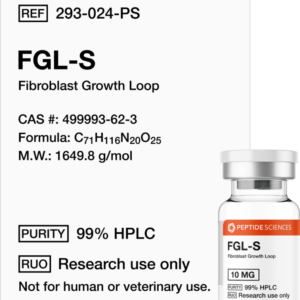
FGL-S 10mg for Laboratory Research
FGL-S 10mg is available in the Peptide Lab Sciences catalogue for laboratory research. Scientific publications describe FGL-type peptides as synthetic mimetics related to a domain of the neural cell adhesion molecule, commonly abbreviated NCAM.
This page explains the research terminology, introduces relevant scientific references and provides a structured review process for laboratories considering FGL-S 10mg.
A product title identifies the catalogue listing, but it does not establish every detail of the supplied preparation. Researchers should review the current specification, available documentation and their laboratory’s requirements before ordering.
Explore the wider research peptides catalogue to compare other laboratory materials. Each product should be assessed individually because similar research categories do not establish identical composition or function.
FGL-S 10mg is supplied for laboratory research only. It is not marketed as a medicine, supplement, cognitive product, neurological treatment or personal-use peptide.
FGL-S 10mg Product Overview
| Product detail | Information |
|---|---|
| Product name | FGL-S 10mg |
| Alternative terminology | FGL-S, FGLS or FGL-S peptide |
| General scientific identity | NCAM-derived FGL-domain mimetic |
| Stated quantity | 10mg |
| Catalogue category | Research Peptides |
| Research context | FGFR signalling and experimental neurobiology |
| Physical format | Confirm from the current specification |
| Composition | Request details where required |
| Identity and purity | Review available batch documentation |
| Storage and handling | Follow instructions for the supplied preparation |
| Intended use | Laboratory research only |
The overview does not confirm a specific production system, purity value, formulation, counterion, carrier or biological activity measurement.
If your project requires any of these details, request the relevant documentation before purchasing FGL-S 10mg.
What Is FGL-S?
FGL-S is described in research as a synthetic peptide mimetic associated with a region of NCAM. NCAM is a cell-adhesion molecule involved in interactions between neural cells and in cellular signalling research.
FGL-type peptides have been studied because their structure can interact with fibroblast growth factor receptor pathways in defined experimental models. The scientific question may involve receptor activation, neurite development, synaptic changes or another measured endpoint.
These terms describe research topics. They do not establish that every FGL-S preparation produces the same result or that a commercial product is suitable for a particular protocol.
The relevant purchasing question is whether the available FGL-S 10mg specification provides the identity and handling information your laboratory requires.
NCAM, FGL and FGL-S Terminology
Scientific publications may use FGL peptide, FGL-S, FGLS or NCAM-derived mimetic terminology. Preserve the exact term used by each paper when recording references.
Use the complete product name, FGL-S 10mg, in your purchasing and inventory records. If your laboratory uses the abbreviation FGL-S, connect it to the full identifier.
This prevents a shortened label from being confused with another FGL-related peptide, modified analogue or experimental derivative.
When comparing studies, check whether the authors used the same sequence, modification and experimental preparation. Similar terminology alone does not prove that two materials are identical.
FGL-S and Fibroblast Growth Factor Receptors
Research has examined FGL-type peptides in relation to fibroblast growth factor receptors, including FGFR1. A study of the FGL peptide reported receptor-related signalling and effects on neurite outgrowth in primary neuronal cultures.
Read the primary study on the NCAM-derived FGL peptide for the original experimental context.
The study describes its own material, cells and measurements. It does not test or certify the FGL-S 10mg listing.
Another publication investigated FGL-S in behavioural and pharmacokinetic studies involving rats and non-human primates. The authors examined a specific research preparation and defined experimental outcomes.
The FGL-S research publication provides further scientific background.
Researchers should keep those findings connected to the models and methods used by the authors.
What Does the 10mg Quantity Mean?
The 10mg declaration identifies the stated product amount. It does not specify a working concentration, experimental dose, purity percentage or biological activity value.
Before ordering FGL-S 10mg, determine whether your laboratory needs information about the quantity basis. For example, your purchasing process may require clarification about the amount of named peptide and any other components.
Do not infer those details from a product photograph, price or general description.
Keep the quantity declaration linked to the specification reviewed at the time of purchase. If additional clarification is provided, retain it with the order record.
Seven Essential Checks Before Ordering FGL-S 10mg
1. Confirm the peptide identity.
Ensure that the project requires FGL-S or the relevant NCAM-derived sequence.
2. Review sequence information.
Check whether the product description supplies the detail needed for comparison with published studies.
3. Confirm the quantity basis.
Establish what the stated 10mg represents.
4. Review the physical presentation.
Request the current specification rather than assuming a format from the photograph.
5. Examine available analytical evidence.
Check the report method, sample reference and batch connection.
6. Confirm handling requirements.
Ensure that the laboratory can receive and manage the preparation appropriately.
7. Retain the decision record.
Save the product specification, order reference and written clarification together.
These checks help make the purchase traceable and easier for colleagues to review.
FGL-S Research Models
FGL-S research may involve isolated proteins, cultured neurons, animal models or behavioural measurements. Each model answers a different scientific question.
A cell-culture study may examine neurite growth or receptor signalling. An animal study may measure behaviour, tissue changes or pharmacokinetics. Results from one model should not automatically be transferred to another.
When reviewing FGL-S literature, record:
- The exact material used
- The experimental model
- The measurement taken
- The comparison group
- The duration of the study
- The limitations reported
This keeps the research interpretation specific and avoids broad claims that exceed the evidence.
Product Documentation and Quality Review
Scientific papers provide research context. Product documentation provides information about the actual material offered for purchase.
For FGL-S 10mg, identify which properties your laboratory needs documented. A statement that a product is “tested” does not explain the test performed or the sample examined.
If a certificate of analysis is available, review its product identifier, batch reference, method, report date and results. Distinguish measured values from acceptance limits.
Visit the Peptide Lab Sciences quality control page for the available documentation framework.
If an essential property is missing, request clarification before ordering.
Comparing FGL-S Research Products
Different FGL-S listings may vary in quantity, sequence, modification, format or documentation. Compare each listing using the same fields.
Record the full product name, quantity, preparation details and available reports. Mark unknown information clearly.
Price alone does not establish identity, purity or suitability. Promotional terms should not replace measurable specifications.
Use the research peptides catalogue to browse related products, then assess each listing against your project requirements.
Preparing a Laboratory Order
Use the complete identifier FGL-S 10mg in the purchase record. Include the receiving laboratory, internal order number and any documentation requirements.
Check the delivery address and ordering terms shown during checkout.
For product questions, contact Peptide Lab Sciences through the contact page and state the exact specification you need.
Receiving FGL-S 10mg
When the shipment arrives, compare the label with the purchasing record. Record the date received, product name, stated quantity and any batch reference.
Document discrepancies in the packaging or supplied information using your laboratory’s receiving procedure.
Keep the product linked to its original order and specification when assigning an internal inventory code.
If information is inconsistent, request clarification before experimental work begins.
Storage and Handling Information
Follow instructions applicable to the supplied FGL-S preparation and your laboratory’s validated procedures.
This page does not provide a universal storage temperature, solvent, shelf life or preparation method.
Do not transfer handling instructions from another FGL-related peptide solely because the names appear similar.
If your laboratory requires a particular storage or handling detail, obtain it before ordering and retain it with the product record.
Frequently Asked Questions
1. What is FGL-S 10mg?
It is a research peptide listing with a stated quantity of 10mg. Scientific literature associates FGL-S with NCAM-derived peptide and FGFR research.
2. What does FGL-S stand for?
FGL-S refers to an FGL-related synthetic peptide designation used in research contexts. Check the exact product specification and sequence information.
3. Is FGL-S the same as every FGL peptide?
Do not assume equivalence. Compare the sequence, modifications and preparation described in each source.
4. What does 10mg mean?
It identifies the stated product quantity. It does not establish concentration, dosage, purity or biological activity.
5. Is FGL-S a medicine?
No. This listing is presented for laboratory research only and is not offered as a licensed medicine or treatment.
6. Does the product title confirm the sequence?
No. Review the current specification for sequence and composition information.
7. Does published research validate this product?
No. Research papers describe the materials used by their authors. They do not certify an individual commercial batch.
8. Is FGL-S intended for cognitive enhancement?
No personal-use claim is made here. The product is supplied for laboratory research.
9. Does the product include a certificate of analysis?
Check the documentation available for the supplied batch. Contact Peptide Lab Sciences if your institution requires specific evidence.
10. How should FGL-S 10mg be stored?
Follow instructions applicable to the supplied preparation and your laboratory’s procedures.
11. Can I request additional documentation?
Yes. Identify FGL-S 10mg and state which specification or report your laboratory requires.
12. Where can I compare other research peptides?
Visit the Research Peptides category and review each product individually.
Review FGL-S 10mg Before Ordering
Select FGL-S 10mg by matching the named peptide, stated quantity, available specification and documentation to your laboratory’s requirements.
Read the linked PubMed studies for their actual experimental context. Keep scientific references separate from product qualification records and retain the information used during purchasing.
For product or documentation questions, contact Peptide Lab Sciences before ordering.
For laboratory research only. Not for human or veterinary use, consumption, injection, diagnosis, treatment or personal administration.
Reviews
There are no reviews yet.