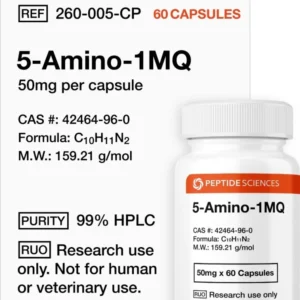
5-Amino-1MQ 50mg for Laboratory Research
5-Amino-1MQ 50mg is listed by Peptide Lab Sciences as a laboratory research material associated with cellular metabolism and enzyme-inhibition studies. The product title identifies a 60-capsule presentation and a stated 50mg amount.
The live product information identifies 5-Amino-1MQ as a small-molecule quinolinium analogue studied as an inhibitor of nicotinamide N-methyltransferase, commonly abbreviated NNMT. Because this is a small molecule, it should be described accurately as a research compound rather than as a peptide.
The product page also states that the capsules are inert containers for dry transport, storage and handling of laboratory research material. They are not dosage forms, consumer capsules or drug delivery systems.
This page explains the scientific terminology, the research context, the stated quantity and the documentation questions laboratories should review before ordering.
A product title identifies the catalogue listing. It does not independently establish purity, manufacturing route, chemical form, stability, biological activity or suitability for a particular experiment.
Browse the Cellular and Metabolic Research category to explore related materials. You can also review the Research Capsules category when comparing capsule-based research listings.
5-Amino-1MQ 50mg is supplied for laboratory research only. It is not offered as a weight-loss product, metabolic supplement, medicine, performance product or personal-use capsule.
5-Amino-1MQ 50mg Product Overview
| Product detail | Information |
|---|---|
| Product name | 5-Amino-1MQ 50mg (60 Capsules) |
| Alternative name | 5-Amino-1MQ or 5A1MQ |
| Compound class | Small-molecule quinolinium analogue |
| Research target | Nicotinamide N-methyltransferase, or NNMT |
| Stated capsule count | 60 |
| Stated quantity | 50mg, according to the product title |
| Catalogue categories | Cellular and Metabolic Research; Research Capsules |
| Capsule status | Inert container for laboratory material |
| Intended use | Laboratory research only |
| Physical composition | Confirm from the current specification |
| Identity and purity | Review available batch documentation |
| Storage and handling | Follow instructions for the supplied preparation |
The overview repeats catalogue information without adding claims about purity, potency, pharmacokinetics, clinical benefit or human safety.
If your laboratory needs the amount per capsule, total amount, chemical form or composition of the capsule contents confirmed, request the applicable documentation before ordering.
What Is 5-Amino-1MQ?
5-Amino-1MQ is a small molecule investigated in research on NNMT. The compound is commonly written as 5-amino-1MQ, 5-amino-1-methylquinolinium or 5A1MQ, depending on the source.
NNMT is an enzyme that transfers a methyl group to nicotinamide. Researchers study NNMT because it connects with cellular metabolism and the handling of methyl-donor and nicotinamide-related compounds.
The scientific interest in 5-Amino-1MQ comes from its use as a chemical probe for investigating NNMT inhibition. A chemical probe can help researchers examine what changes when a particular enzyme is inhibited under defined conditions.
That research role does not make 5-Amino-1MQ a medicine or supplement. It remains important to distinguish a laboratory inhibitor from a product intended for personal use.
Why NNMT Matters in Cellular Research
NNMT participates in the metabolism of nicotinamide and can influence related metabolite levels. Researchers have examined NNMT in adipose tissue, skeletal muscle, liver and other systems.
The outcome of NNMT inhibition can depend on cell type, experimental conditions, exposure duration and the other metabolic pathways active in the model.
A study may measure:
- NNMT enzyme activity
- Nicotinamide metabolites
- NAD-related compounds
- Methyl-donor balance
- Gene expression
- Lipid metabolism
- Glucose-related markers
- Cellular redox status
Each measurement answers a different question. A change in one metabolite does not automatically establish a change in whole-body metabolism.
When reviewing 5-Amino-1MQ research, record the model and endpoint instead of relying on a broad statement such as “metabolism support.”
5-Amino-1MQ and NAD-Related Pathways
Nicotinamide is connected with NAD metabolism. Researchers often investigate NAD-related pathways because they contribute to redox reactions, energy metabolism and cellular signalling.
NNMT converts nicotinamide into 1-methylnicotinamide. Inhibiting NNMT can therefore alter the balance of metabolites measured in a particular model.
A change in NAD-related metabolites should be interpreted in relation to the full experimental design. Researchers should review the assay, controls, tissue type and timing.
The existence of a biochemical relationship does not establish that a capsule product produces a specific result in humans.
For 5-Amino-1MQ 50mg, product selection still depends on the actual specification and documentation for the supplied material.
Published Research on 5-Amino-1MQ
A study of selective, membrane-permeable NNMT inhibitors investigated 5-Amino-1MQ in cellular and animal models. The researchers examined metabolic outcomes in diet-induced obese mice and measured changes in body composition, glucose tolerance and related variables.
Read the primary 5-Amino-1MQ NNMT study for the original material, model and methods.
A newer study assessed 5A1MQ in diet-induced obese mice and examined body composition, metabolic markers, liver findings and pharmacokinetic distribution. The publication describes a defined animal study, not a human treatment recommendation.
Read the 5A1MQ metabolic dysfunction study for additional research context.
Another paper developed and validated an LC-MS/MS assay for 5-amino-1-methyl quinolinium in rat plasma. This type of work is relevant to analytical measurement and pharmacokinetics.
The LC-MS/MS assay publication explains how the compound was measured in an experimental setting.
These references do not validate the identity, purity or activity of the 5-Amino-1MQ 50mg product listed here.
Research Models and Their Limitations
5-Amino-1MQ research includes enzyme assays, cultured cells, animal studies and analytical methods. Each model has a defined purpose and limitation.
An enzyme assay can help researchers measure inhibition under controlled conditions. A cell study can examine metabolic or transcriptional changes. An animal model can provide information about distribution and physiological measurements.
None of these models answers every question about a commercial capsule presentation.
When reading a 5-Amino-1MQ paper, record:
- The exact compound name
- The chemical form
- The experimental model
- The amount or concentration used
- The route used in the model
- The endpoint measured
- The duration
- The controls
- The limitations
This information prevents a preclinical result from being presented as a general human claim.
What Does 50mg Mean?
The product title states 50mg and 60 capsules. Researchers should confirm how the quantity declaration is defined in the current specification.
The stated amount does not establish a working concentration, experimental dose, purity percentage or biological activity.
The capsules are described as inert containers for laboratory material. They are not dosage forms and are not intended for ingestion.
If your project requires the precise amount of 5-Amino-1MQ per capsule, request composition information before ordering.
Keep the quantity declaration connected to the product identifier, selected listing and batch reference.
Understanding the Capsule Presentation
A capsule can describe the container used to organise dry laboratory material. It does not necessarily describe a finished pharmaceutical dosage form.
The product page specifically states that the capsules are not intended for ingestion, administration or use as drug delivery systems.
This information should remain visible in the product description and should not be replaced with language suggesting oral use, supplementation or personal dosing.
When receiving 5-Amino-1MQ 50mg, compare the capsule count, label and stated quantity with the order record.
If the product is required for an analytical or cellular experiment, follow the applicable laboratory procedures and documentation.
Seven Essential Checks Before Ordering
1. Confirm the compound identity.
Check that your project requires 5-Amino-1MQ or 5A1MQ rather than another NNMT inhibitor.
2. Confirm the chemical description.
Review the available name, structure and chemical form.
3. Confirm the quantity basis.
Establish what the stated 50mg represents.
4. Confirm the capsule count.
Check that the 60-capsule presentation matches the listing selected.
5. Review analytical documentation.
Check the batch reference, method and results in any available report.
6. Confirm handling information.
Ensure that your laboratory can receive and manage the material under its procedures.
7. Retain the purchasing record.
Save the product specification, order reference and clarification together.
Product Identity and Quality Documentation
Scientific papers provide research context. Product documentation provides information about the material offered by the supplier.
For 5-Amino-1MQ 50mg, determine whether your laboratory requires evidence about identity, composition, purity, quantity or storage.
A statement such as “tested” does not identify the test performed or the sample examined.
If a certificate of analysis is available, review:
- Product name
- Chemical identifier
- Batch number
- Report date
- Test method
- Measured result
- Specification limit
- Issuing laboratory
Do not assume that a report for another NNMT inhibitor applies to 5-Amino-1MQ.
Visit the quality control page when reviewing available information.
Comparing NNMT Inhibitors
5-Amino-1MQ is one of several compounds studied as an NNMT inhibitor. Other inhibitors may differ in structure, selectivity, potency, permeability and experimental use.
Do not treat every NNMT inhibitor as interchangeable.
When comparing research compounds, record:
- Complete chemical name
- Structure or identifier
- Target enzyme
- Stated quantity
- Physical presentation
- Available analytical evidence
- Experimental model
- Handling information
A product category can help organise browsing, but it does not establish equivalence.
5-Amino-1MQ and Other Cellular Research Compounds
Cellular and metabolic research includes compounds that affect different enzymes, receptors and pathways.
A product described as an NNMT inhibitor should not be compared directly with NAD+, mitochondrial agents or hormone-related peptides without identifying the research question.
The relevant comparison depends on the experiment. Researchers may be interested in enzyme selectivity, metabolite changes, tissue distribution or cellular viability.
Use the Cellular and Metabolic Research category to browse related materials while keeping each compound’s identity separate.
Responsible Laboratory Use
5-Amino-1MQ 50mg is supplied for laboratory research only.
It is not intended for ingestion, weight management, bodybuilding, metabolic treatment, supplementation or personal experimentation.
The capsules are not dosage forms or drug delivery systems.
Researchers are responsible for ensuring that purchase, possession, handling, storage and use comply with applicable law, institutional policy and laboratory safety requirements.
This page does not provide administration instructions, dosing schedules, reconstitution procedures or treatment advice.
Planning an Institutional Order
Use the complete product name 5-Amino-1MQ 50mg (60 Capsules) in the purchasing record.
Include the stated 50mg quantity and 60-capsule presentation. If your institution requires a specific chemical identifier or analytical document, include that requirement in the order review.
Add the receiving laboratory, internal project reference and responsible contact.
Check the delivery address and ordering terms during checkout.
For questions, use the Peptide Lab Sciences contact page and identify the exact product name.
Receiving 5-Amino-1MQ 50mg
When the shipment arrives, compare the label with the purchase record.
Record:
- Date received
- Complete product name
- Capsule count
- Stated quantity
- Batch reference
- Packaging condition
- Accompanying documents
- Internal inventory number
Document any discrepancy using your laboratory’s receiving procedure.
If the shipment does not match the selected listing, request clarification before experimental work begins.
Storage and Handling Information
Follow instructions applicable to the actual 5-Amino-1MQ preparation supplied.
This page does not provide a universal storage temperature, shelf life or handling method.
Do not transfer instructions from another capsule product or NNMT inhibitor solely because the packaging appears similar.
If your laboratory requires a specific storage or handling detail, obtain it before ordering and retain it with the product record.
Building a Traceable Research Record
A traceable research record should connect the material, source, quantity and supporting documentation.
For 5-Amino-1MQ 50mg, retain:
- Full product name
- Product URL
- Selected quantity
- Capsule count
- Chemical identifier
- Batch reference
- Certificate or report
- Relevant PubMed references
- Internal inventory code
If the project changes from 5-Amino-1MQ to another NNMT inhibitor, document the change explicitly.
Do not allow the general term “NNMT inhibitor” to conceal a change in chemical structure.
Reading Metabolic Studies Carefully
When reviewing a 5-Amino-1MQ study, identify whether the authors measured body composition, glucose tolerance, liver markers, metabolite levels or another endpoint.
Record the species, tissue, exposure period and controls.
An animal study can help researchers formulate a hypothesis, but it does not establish a human treatment effect.
Likewise, an analytical method can measure the compound without proving that the preparation has a particular biological outcome.
Keep each conclusion within the evidence provided by the source.
Frequently Asked Questions
1. What is 5-Amino-1MQ 50mg?
It is a research listing identified as 5-Amino-1MQ with a stated 50mg quantity and 60-capsule presentation.
2. What is 5-Amino-1MQ studied for?
Research examines it as an inhibitor of nicotinamide N-methyltransferase, or NNMT.
3. Is 5-Amino-1MQ a peptide?
No. It is described as a small-molecule quinolinium analogue.
4. What does NNMT mean?
NNMT stands for nicotinamide N-methyltransferase, an enzyme involved in nicotinamide metabolism.
5. Does 50mg describe a dose?
No. It identifies the stated product quantity and is not an administration instruction.
6. Are the capsules intended for ingestion?
No. The listing describes them as inert containers for laboratory research material.
7. Is this product a supplement?
No. It is presented for laboratory research only.
8. Is 5-Amino-1MQ approved as a medicine?
No medicine or treatment claim is made here. The product is supplied as research material.
9. Does the product title prove purity?
No. Purity requires relevant documentation for the actual supplied batch.
10. Does a PubMed paper validate this product?
No. Publications describe the materials and methods used by their authors. They do not certify a commercial batch.
11. Is 5-Amino-1MQ the same as every NNMT inhibitor?
No. NNMT inhibitors can differ in structure, selectivity and research properties.
12. Does 5-Amino-1MQ increase NAD+ in every model?
No general conclusion should be made. Results depend on the model, conditions and measurements used.
13. Can I use the capsules as a drug delivery system?
No. The capsules are not intended for that purpose.
14. Does 60 capsules confirm the amount per capsule?
Review the current composition and quantity specification. The title alone does not answer every formulation question.
15. Is this product intended for weight loss?
No personal-use or weight-loss claim is made. The product is supplied for laboratory research.
16. Can I compare this product with NAD+?
Only after identifying the research question and the exact materials. They are different research subjects.
17. Does the product come with a certificate of analysis?
Check the documentation available for the supplied batch and contact Peptide Lab Sciences if a specific report is required.
18. How should 5-Amino-1MQ be stored?
Follow instructions applicable to the supplied preparation and your laboratory’s procedures.
19. Can I request more information before ordering?
Yes. Contact Peptide Lab Sciences with the complete product name and the exact document required.
20. Where can I compare related products?
Visit the Cellular and Metabolic Research category and Research Capsules category.
Review 5-Amino-1MQ 50mg Before Ordering
Select 5-Amino-1MQ 50mg by confirming the compound identity, NNMT research context, stated quantity and 60-capsule presentation.
Remember that 5-Amino-1MQ is a small-molecule research compound rather than a peptide. Preserve that distinction in product records, category descriptions and scientific references.
The capsules are described as inert containers for dry transport, storage and handling. They are not dosage forms, drug delivery systems or products for ingestion.
Read the linked PubMed studies for their actual experimental models and limitations. Keep scientific references separate from product qualification documents.
For product or documentation questions, contact Peptide Lab Sciences before ordering.
For laboratory research only. Not for human or veterinary use, consumption, injection, diagnosis, treatment or personal administration.
Reviews
There are no reviews yet.