Research peptides vs metabolic compounds is a comparison of chemical identity, not a contest between interchangeable product types. “Research peptides” and “metabolic research compounds” are related catalogue terms, but they do not describe the same chemical class. One refers principally to molecules built from amino-acid residues connected through peptide bonds; the other describes an area of scientific investigation that can involve peptides, nucleotides, cofactors and many other substances. Understanding that difference helps laboratory buyers search the right category and avoid selecting a material simply because it appears alongside familiar products.
This guide is intended for institutional purchasers and research teams working with lawful laboratory materials. It compares terminology, molecular identity, product formats and documentation—without presenting experimental compounds as consumer medicines or supplements.
What makes a molecule a peptide?
A peptide comprises amino-acid residues joined by peptide bonds. Its scientific identity may depend on sequence, residue modifications, terminal groups, stereochemistry and chemical conjugates. Even a short sequence can have important variants, so an abbreviated catalogue name may not be a sufficient material identifier.
Laboratory descriptions often refer to a substance as a dipeptide, tripeptide, tetrapeptide or longer peptide according to its constituent residues. Some compounds are fragments of larger proteins; others are designed analogues. Chemical modifications may mean that two names in the same general family do not refer to identical materials.
The Research Peptides category at Peptide Lab Sciences offers a practical browsing route, but category membership should not be treated as proof of sequence, chemical form, purity or experimental suitability. The buyer must verify the exact material on its own listing.
What does cellular and metabolic research describe?
Cellular and metabolic research is organised around scientific questions, not one molecular structure. Laboratories may investigate biochemical pathways associated with energy transfer, signalling, enzymatic reactions, redox chemistry or cellular responses. Different molecules can be used to study different parts of these systems.
For this reason, a metabolic-research category may contain both peptide and non-peptide materials. The Cellular and Metabolic Research category currently groups products under one research theme, including NAD+, MOTS-C, Humanin, AICAR and other compounds. Their appearance in the same category does not establish that they are chemical equivalents or share a common mechanism.
A buyer should therefore read the complete substance name and chemical specification rather than assuming that every entry is a peptide. This is particularly useful when a procurement request arrives with only a short abbreviation.
Comparing MOTS-C and NAD+ as classification examples
MOTS-C is described in peer-reviewed literature indexed by PubMed as a mitochondrial-derived peptide associated with questions about cellular signalling and metabolism. Its identity needs to be considered in terms of the specific peptide sequence and supplied chemical preparation.
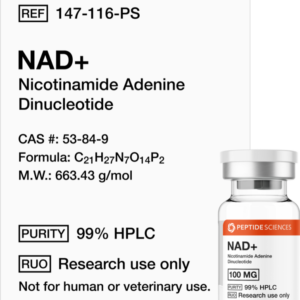
NAD+—nicotinamide adenine dinucleotide—is a coenzyme rather than a peptide, as reflected in PubChem’s NAD+ chemical record. It participates in oxidation–reduction chemistry and serves as a substrate in several cellular processes. The abbreviation identifies a very different class of molecule and should not be grouped with peptides merely because both may be discussed in metabolic research.
The verified NAD+ product listing and other catalogue entries can help researchers locate a named material, but a product title is not a substitute for a complete technical document. At the time of review, the listing offered selectable 100 mg and 750 mg variants; availability and options can change. Compare the chosen variation, intended substance, form and quantity with the laboratory brief before making an ordering decision.
| Comparison point | Peptide example: MOTS-C | Non-peptide example: NAD+ |
|---|---|---|
| Broad chemical class | Mitochondrial-derived peptide | Nucleotide-derived coenzyme |
| Identity evidence to review | Sequence, molecular mass, chemical form and batch data | Complete chemical identity, form, assay and batch data |
| Why it appears in a metabolic category | Investigated in cellular signalling and metabolism research | Participates in cellular redox chemistry and acts as an enzyme substrate |
| What category placement proves | Only a navigation relationship; it does not prove interchangeability, equivalent testing or suitability for the same experiment | |
Why chemical classes affect analytical verification
Characterisation methods need to fit the substance under investigation. A peptide’s identity may require checks related to molecular mass, sequence or particular modifications. A small non-peptide molecule may require a different analytical approach, reference standard or impurity assessment. There is no single test that establishes every quality attribute of all compounds in a metabolic-research catalogue.
For broader biologic characterisation, the EMA’s ICH Q6B guidance illustrates how specifications distinguish identity, purity, impurities and other attributes. Its scope is biotechnological and biological products and explicitly does not cover synthetic peptides or cell metabolites, so it should not be misapplied as a product-specific standard for the catalogue materials discussed here.
The practical lesson is to request an appropriate set of tests for the actual compound and the purpose of the experiment. The familiar presence of “HPLC tested” wording does not confirm that every relevant quality attribute has been established.
Product formats do not determine molecular class
A material can be sold in different presentations. For example, the Research Capsules category is based on physical package format rather than a shared chemical structure. Materials listed as capsules may include peptides and non-peptides.
A stated amount such as milligrams per capsule should be distinguished from total mass across the package, and both from the complete filled weight. Any other formulation components may matter to a controlled laboratory application. The presence of a capsule does not mean a research material is approved for ingestion or therapeutic use.
Similarly, a vial or powder presentation does not establish that a chemical is a peptide. Buyers should avoid inferring identity, handling requirements or experimental properties from packaging photographs.
A consistent way to research unfamiliar catalogue names
Begin with the complete product name, including modifiers and any abbreviation in brackets. Identify the likely chemical class from a reliable source. Confirm the sequence or formula where it is relevant and check whether the same name is used for multiple forms in the literature. Note the selected product amount and physical format separately.
Next, determine which publication or technical source addresses the compound being considered. A paper about a structurally related molecule can provide context, but its findings should not automatically be transferred to a different substance. Record the method and model used in each relevant study.
Finally, review the actual supplier information: batch identifier, specification, available test data and any outstanding questions. This process makes the search journey useful for both readers who are learning a term and laboratories that are preparing a purchase record.
Preventing keyword confusion when searching for compounds
Search engines can show consumer wellness pages, speculative social-media claims and scientific publications for the same short abbreviation. Research teams should differentiate these sources rather than selecting information solely because it uses an exact keyword.
A useful search string includes the full chemical name, an analytical term and the word “research” or “structure”. For literature review, search titles and methods to ensure that the compound and form match the laboratory question. If a search result promises a medical outcome without specifying study design or limitations, it is weak evidence for research purchasing decisions.
This discipline also reduces misleading SEO content. An educational page should answer the user’s real question—such as “Is NAD+ a peptide?”—directly instead of burying the answer under repeated commercial keywords.
How to navigate the Peptide Lab Sciences catalogue
Begin at the Peptide Lab Sciences homepage or the shop for the broad catalogue. Use Research Peptides if you need an individual peptide listing, Cellular and Metabolic Research for substances grouped by a broader research theme, or Research Capsules for a particular laboratory product presentation. Individual items may belong to more than one category.
When the product matches a procurement brief, open its listing and check the full name, selected variation and available documentation. Use the supplier’s contact route for essential missing information. No product should be chosen simply because its description mentions a desired biological outcome.
Research-only products and regulatory boundaries
Catalogue terms such as “metabolic”, “cellular”, “longevity” or “performance” do not provide evidence that a material is approved for treating disease or suitable for administration. In the UK, MHRA borderline-product guidance explains how claims, ingredients, intended purpose and presentation affect whether a product is a medicine. Legal status and permitted supply depend on the actual substance and applicable rules. A research-use disclaimer does not override legal obligations.
Laboratories should follow institutional purchasing, health-and-safety and scientific ethics procedures. Do not treat a laboratory product as interchangeable with a licensed medicine or a finished consumer product.
Frequently asked questions
Are all metabolic research compounds peptides?
No. The term refers to a research area that includes peptide and non-peptide molecules.
Is NAD+ a peptide?
No. NAD+ is nicotinamide adenine dinucleotide, a coenzyme with a different chemical structure from peptides.
Is MOTS-C discussed in metabolic research?
Yes. MOTS-C is a peptide investigated in research related to mitochondrial signalling and metabolism, though the significance of individual findings depends on their models and methods.
Does sharing a category mean two compounds are interchangeable?
No. Shared categories help navigation and do not prove equivalent chemical identity, experimental purpose or handling requirements.
Where should an institutional buyer look first?
Start with the Peptide Lab Sciences shop and select the category and exact product corresponding to the written purchasing specification.
Research-use notice: This is laboratory classification and procurement information, not medical advice. Research-only compounds are not intended for human or veterinary consumption, administration, diagnosis or treatment.
Scientific and catalogue sources reviewed 10 October 2026. Product options and availability should be verified on the live listing before purchase.