Peptide purity testing helps researchers assess what is in a sample before they interpret an experiment. A percentage on a product page is only one part of that assessment. Chromatographic purity, molecular identity, peptide content and biological activity answer different questions, and none should be substituted for the others.
This guide explains how to read HPLC and mass spectrometry results alongside a certificate of analysis (COA). It is written for laboratory researchers and procurement teams reviewing the Peptides Lab Sciences research catalogue. Catalogue descriptions are a starting point for enquiries; they are not independent proof of a particular batch’s analytical properties.
What does peptide purity testing actually measure?
Begin with the claim being tested. Does the report describe the proportion of chromatographic signal assigned to the target peptide, the mass of peptide in a container, the identity of a molecular species, or an effect measured in an assay? These measurements can support one another, but they are not interchangeable.
| Measurement | Useful question | Important limitation |
|---|---|---|
| HPLC area purity | How much of the integrated detector signal belongs to the target peak? | Depends on separation, detection and integration. |
| Mass spectrometry | Does the observed molecular mass agree with the expected species? | Matching mass alone may not establish the complete sequence or distinguish all isomers. |
| Peptide content assay | How much actual peptide is present? | Requires an appropriate quantitative method and a clearly defined reporting basis. |
| Biological activity assay | Does the sample produce the specified assay response? | Results depend on the model, controls and experimental conditions. |
| Microbiological testing | What does the stated contamination test show? | Not established by HPLC purity or molecular mass. |
How HPLC separates peptide components
High-performance liquid chromatography passes a sample through a column while a detector records components as they elute. In reversed-phase methods, interactions between the sample, stationary phase and mobile phase help separate compounds. The resulting chromatogram plots detector response against time.
A retention time identifies when a peak appears under that method. It is not a universal fingerprint: changing the column, solvent composition, temperature or gradient can change it. A useful report therefore records enough method information to interpret the result and compare it with an appropriate reference.
Reading area percentages without overinterpreting them
Area purity commonly expresses the integrated target peak as a fraction of the total integrated peak area. Its meaning depends on which peaks were included, the detector settings and the rules used for integration. Ask whether the chromatogram shows the full relevant run and whether the report explains how the target peak was assigned.
Two substances can sometimes elute together. A single prominent peak therefore does not automatically mean a sample contains only one chemical species. Components that give little response at the chosen detector settings may also be poorly represented. These are reasons to examine the method and use complementary analysis, rather than reject chromatography itself.
What mass spectrometry adds
Mass spectrometry measures ions according to mass-to-charge ratio. For peptides, analysts interpret the observed ions, charge states and processing results to assess molecular mass. Comparing the measured result with the expected target mass supports identity assessment.
The expected mass must correspond to the actual requested form. Terminal modifications, conjugation and other chemical changes can alter it. A procurement record should therefore identify the sequence and modifications clearly enough that an analyst knows which molecular species is intended.
An appropriate mass result can support an HPLC interpretation, but it should not be turned into an unsupported claim of full sequence confirmation. Some molecules share a mass or have closely related structures. Depending on the question, tandem mass spectrometry, reference materials or additional techniques may be needed.
Purity is different from net peptide content
A dry material can include water, counterions or other components in addition to peptide. A chromatographic area percentage does not necessarily tell you how many milligrams of peptide are present in the weighed material. Equally, a container’s nominal quantity does not explain whether it refers to gross material, peptide content or another defined basis.
Hypothetical example: suppose a sample has a reported HPLC area purity of 98% and a separately measured peptide content of 80% by mass. These figures describe different measurements. If the container holds 10 mg of material on the same defined mass basis, the content result would correspond to 8 mg of peptide. Multiplying 10 mg by the HPLC area percentage alone would not establish the peptide mass.
This example is educational and does not describe any Peptides Lab Sciences product or batch. For actual purchasing decisions, request the reporting basis, measurement method and any relevant uncertainty from the supplier or testing laboratory.
A practical certificate of analysis checklist
- Match the batch. Check that the lot identifier on the report matches the supplied container and order record.
- Confirm the material. Compare the name, sequence, modifications and specified form with the experimental requirement.
- Separate specifications from results. A target acceptance criterion is not itself a measured result.
- Inspect the analytical evidence. Look for the chromatogram, mass result and sufficient method details to interpret them.
- Check the dates. Distinguish manufacture, analysis, issue and any stated retest dates.
- Understand the laboratory’s role. Establish who tested the sample and what the report actually covers.
- Resolve missing fields. Obtain clarification before assuming that an omitted test was passed.
Keep the report with the experimental record. Record the supplier, purchase date, received lot and storage history so that a later result can be traced to the material used. When documentation is inconsistent, pause interpretation until the discrepancy is resolved.
Why method validation matters
An analytical method needs to be suitable for its intended question. Selectivity, accuracy, precision and other performance characteristics can matter in different ways depending on whether the method tests identity, quantifies an impurity or measures content. A method that is useful for one purpose should not automatically be treated as validated for every purpose.
The EMA’s ICH Q2(R2) analytical validation resource and the FDA’s Q2(R2) guidance page provide further context. These resources describe analytical validation; linking to them does not mean this supplier or its catalogue has regulatory approval or ICH certification.
Applying the checklist to catalogue enquiries
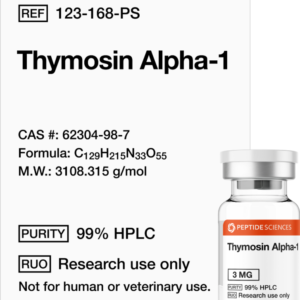
For a listing such as Thymosin Alpha-1, ask for documentation linked to the exact lot being offered. For a quantity-specific listing such as Tesamorelin 5 mg, also clarify the basis of the stated quantity. These links are examples of catalogue navigation, not endorsements of a batch’s quality or suitability.
For an introduction to the wider analytical workflow, Agilent’s peptide standards resource discusses peptide analysis and reference materials. Select standards and methods according to your own laboratory’s validated procedures.
Frequently asked questions
1. Does 99% HPLC purity mean 99% of the vial’s weight is peptide?
No. A chromatographic area result and a mass-based peptide content result are different measurements. Ask which method and reporting basis support each claim.
2. Can mass spectrometry replace HPLC?
They provide complementary information. Mass spectrometry supports assessment of molecular species, while chromatography separates components. The appropriate combination depends on the analytical question.
3. Does a COA prove sterility?
Only a relevant, explicitly reported test can support a claim within its scope. HPLC purity and matching molecular mass do not establish sterility or acceptable endotoxin levels.
4. Is a report for another batch sufficient?
It may illustrate a supplier’s reporting format, but it does not establish the measured properties of the batch you received. Request lot-specific evidence.
5. Does research use only mean a peptide is approved for people?
No. Analytical quality documentation does not establish approval, safety or effectiveness for human use. This article explains laboratory evidence and provides no clinical or administration guidance.