Decapeptide-12 for Topical Laboratory Research
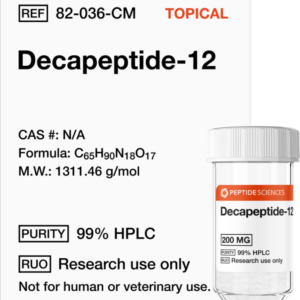
Decapeptide-12 is listed by Peptide Lab Sciences as a research material for topical and cosmetic chemistry studies. The product page identifies a ten-residue sequence and associates the peptide with research into tyrosinase regulation, melanogenesis and pigmentation-related cellular models.
This page explains the scientific terminology, product identity, topical research context and documentation questions that laboratories should review before ordering. It also separates evidence about the named peptide from claims about any finished formulation.
The word “topical” describes the research context or intended material category. It does not automatically mean that the product is a regulated cosmetic, a ready-to-use serum or a preparation approved for application to human skin.
Researchers should evaluate the current product specification, sequence information, composition, physical presentation and available analytical documents. If an essential detail is not stated, request clarification before purchase.
Browse the Cosmetic and Topical Research Peptides category to compare related materials. If the category is not yet active, review the wider research peptides catalogue.
Decapeptide-12 is supplied for laboratory research only. It is not offered as a medicine, supplement, skincare treatment, skin-lightening product or personal-use cosmetic.
Decapeptide-12 Product Overview
| Product detail | Information |
|---|---|
| Product name | Decapeptide-12 (Topical) |
| Named peptide | Decapeptide-12 |
| Stated sequence | Tyr-Arg-Ser-Ala-Asp-Gly-Tyr-Gln-Gly-Leu |
| Sequence length | Ten amino-acid residues, according to the listing |
| General research context | Tyrosinase and melanogenesis research |
| Product category | Cosmetic and Topical Research Peptides |
| Physical format | Confirm from the current specification |
| Formulation status | Do not assume a finished cosmetic formulation |
| Identity and purity | Review available batch documentation |
| Storage and handling | Follow instructions for the supplied preparation |
| Intended use | Laboratory research only |
This overview repeats the catalogue information without creating unsupported claims about purity, stability, production method, clinical performance or consumer safety.
When your project depends on a particular formulation or analytical property, request the relevant information before ordering Decapeptide-12.
What Is Decapeptide-12?
Decapeptide-12 is a synthetic peptide sequence discussed in cosmetic science and pigmentation research. The name “decapeptide” indicates a peptide containing ten amino-acid residues.
The sequence shown on the product page is Tyr-Arg-Ser-Ala-Asp-Gly-Tyr-Gln-Gly-Leu. Researchers should preserve that sequence in their records and compare it with the material described in the scientific literature.
A peptide sequence identifies the order of residues. It does not independently establish purity, chemical form, biological activity or suitability for a specific formulation.
When reviewing Decapeptide-12 research, examine the experimental material, concentration, vehicle, cell model and outcome measured by the investigators.
Do not assume that a result involving a peptide in a formulated cream applies to every Decapeptide-12 preparation or to the research material listed on this page.
Understanding Tyrosinase Research
Tyrosinase is an enzyme involved in melanin production. Because melanin contributes to pigmentation, researchers study tyrosinase when investigating melanogenesis and pigment-related pathways.
A tyrosinase assay may measure enzyme activity under controlled laboratory conditions. The result may help researchers understand a mechanism, but it does not automatically establish how a finished product behaves on human skin.
When reviewing Decapeptide-12 research, distinguish between:
- Enzyme assays
- Cultured melanocyte studies
- Reconstructed skin models
- Animal studies
- Finished cosmetic formulation trials
- Human clinical studies
Each model answers a different question. A result in one system should not be transferred to another without examining the methods.
The review of tyrosinase and melanogenesis research provides useful background on topical Decapeptide-12 research and its study design.
This reference provides scientific context. It does not certify the product listed by Peptide Lab Sciences.
Decapeptide-12 and Melanogenesis
Melanogenesis describes the biological process through which pigment is produced. Research into melanogenesis may involve enzyme activity, gene expression, melanosome formation, pigment transfer and changes in cellular signalling.
Decapeptide-12 has been investigated in this area because researchers are interested in peptide approaches to pigmentation regulation.
The product description should avoid promising a specific change in skin colour or claiming that the material treats a medical condition. Such conclusions require appropriate clinical evidence and regulatory classification.
For laboratory work, identify the precise endpoint of interest. A project may be measuring tyrosinase activity, melanin content, pigmentation intensity or another marker.
Record the endpoint alongside the material and experimental conditions. This helps prevent a broad research term from being mistaken for a universal product effect.
Why the Sequence Matters
A sequence difference can create a different peptide or analogue. Researchers should therefore confirm that the material required by a protocol matches the sequence listed for Decapeptide-12.
Use the complete sequence in internal records where sequence identity matters. Preserve the format used in the scientific paper and the supplier’s product specification.
Do not assume that a product described only as a “brightening peptide” is equivalent to Decapeptide-12. Marketing categories are broader than chemical identities.
If a paper uses a modified, conjugated or protected form of the peptide, record that difference clearly.
This approach improves reproducibility and helps colleagues understand which material was selected.
What Does “Topical” Mean Here?
The word “topical” identifies the research area or product classification. It does not establish that the listing is a finished cosmetic product.
A laboratory may study a topical formulation, a peptide ingredient, a delivery system or a skin model. Those materials can have different specifications and quality requirements.
Before ordering Decapeptide-12, establish whether your project requires:
- A named peptide
- A topical vehicle
- A finished formulation
- A research ingredient
- A reconstructed skin model
- An analytical reference material
The product page should not be interpreted as supplying all these possibilities. Review the current specification and ask for clarification where necessary.
Decapeptide-12 Research in Cosmetic Science
Cosmetic science often examines ingredients through a sequence of stages. Researchers may first investigate molecular interactions, then test a formulation in a laboratory model and finally assess a finished product under a defined study design.
These stages should not be merged into one claim.
An enzyme result may support further research. A cell model may provide additional biological context. A formulation study may examine delivery and tolerability. A human study may measure a cosmetic outcome over a limited period.
When evaluating Decapeptide-12, identify which stage a source represents. This makes the literature review more precise and prevents overstatement.
Published Decapeptide-12 Studies
A publication evaluating a Decapeptide-12-containing skin-brightening system examined the peptide alongside other ingredients, including a cleanser, glycolic-acid moisturiser and sunscreen. Because multiple components were used, the result cannot automatically be attributed to Decapeptide-12 alone.
Read the open-label Decapeptide-12 formulation study for the original design and limitations.
Another publication examined Decapeptide-12 in a system that included glycolic acid and sunscreen. Again, the formulation context matters when interpreting the findings.
The study of Decapeptide-12 with glycolic acid provides further context.
A more recent clinical trial investigated a different PTPD-12-containing cream. Researchers should not assume that PTPD-12 and Decapeptide-12 represent the same material. Compare the full names, chemical descriptions and methods before connecting the studies.
The PTPD-12 clinical study illustrates why precise peptide terminology matters.
These papers provide research background. They do not validate the identity, stability, purity or performance of the commercial listing.
Decapeptide-12 Versus Other Cosmetic Peptides
Cosmetic peptide products can have different functions, sequences and formulation roles. Decapeptide-12 should not be treated as equivalent to tetrapeptides, hexapeptides, palmitoylated peptides or unrelated pigment-regulating ingredients.
When comparing products, record:
- Complete peptide name
- Sequence
- Modifications
- Stated quantity
- Formulation
- Intended research model
- Available documentation
Do not rely only on words such as brightening, illuminating, tone-correcting or pigment-control. Those terms can describe a marketing category rather than a confirmed chemical identity.
What Does the Product Quantity Mean?
The live page does not state a mass quantity in the title. That means researchers should confirm the supplied amount, physical format and composition before ordering.
Do not infer quantity from the product price, product image or the phrase “topical.”
If a laboratory requires a particular amount of Decapeptide-12, request the current specification and retain it with the purchase record.
The quantity basis should remain connected to the batch or product identifier used during procurement.
Seven Essential Checks Before Ordering Decapeptide-12
1. Confirm the peptide name.
Ensure that the project requires Decapeptide-12 rather than another cosmetic peptide.
2. Verify the sequence.
Compare the listed sequence with the material required by your protocol.
3. Confirm the quantity.
Request the stated amount and quantity basis if they are not clearly displayed.
4. Confirm the physical format.
Determine whether the listing is a research material, ingredient or formulated preparation.
5. Review composition information.
Establish whether additional ingredients are present.
6. Examine documentation.
Check the identity, batch reference and tests included in any available report.
7. Retain the purchasing record.
Save the specification, order reference and written clarifications together.
Product Identity and Quality Documentation
Scientific publications explain the research context. Product documentation addresses the specific material supplied for purchase.
For Decapeptide-12, laboratories may need information about sequence, quantity, chemical form, purity, physical presentation and formulation.
A claim that a product is “tested” does not explain the test performed or the sample examined.
If a certificate of analysis is available, review:
- Product name
- Batch number
- Report date
- Sample reference
- Analytical method
- Measured results
- Acceptance limits
- Issuing laboratory
Visit the Peptide Lab Sciences quality control page when reviewing available information.
If a required property remains undocumented, request clarification before ordering.
Formulation and Stability Questions
Topical research often depends on formulation conditions. A peptide may be evaluated in a cream, gel, serum, buffer or another vehicle.
The vehicle can influence stability, delivery, solubility and observed activity. Therefore, a peptide sequence alone does not describe the complete research system.
Before ordering Decapeptide-12, determine whether your project requires information about:
- Vehicle composition
- pH
- Concentration
- Preservatives
- Solubility
- Stability period
- Packaging
- Light or temperature sensitivity
Do not assume that a research peptide listing includes a finished topical formulation.
Responsible Topical Research
Decapeptide-12 is supplied for laboratory research only. It is not offered for application to human skin, personal cosmetic use, treatment of hyperpigmentation or skin-lightening outside an appropriately regulated finished product.
Researchers are responsible for following institutional safety procedures and applicable regulations.
The product page does not provide consumer application instructions, patch-testing instructions, treatment schedules or cosmetic claims.
Comparing Decapeptide-12 Listings
Different listings may use the same name while providing different sequence, quantity, modification or formulation information.
Use a comparison table with the following fields:
- Product name
- Exact sequence
- Quantity
- Physical format
- Formulation
- Batch reference
- Identity evidence
- Purity information
- Storage and handling details
Mark unknown information clearly. Do not treat an unconfirmed field as equivalent to a verified specification.
Planning a Laboratory Order
Use the full product name Decapeptide-12 (Topical) in your purchase record.
State whether your project requires a peptide ingredient, a topical research preparation or a formulated test material.
Include the receiving laboratory, internal order reference and documentation requirements.
Check the delivery address and ordering terms during checkout.
For clarification, use the Peptide Lab Sciences contact page and identify the complete product name.
Receiving Decapeptide-12
When the shipment arrives, compare the label with the purchase record.
Record:
- Date received
- Product name
- Quantity
- Sequence information
- Batch reference
- Packaging condition
- Accompanying documents
Document discrepancies using your laboratory’s receiving process.
If the supplied format or quantity differs from the order record, request clarification before experimental work begins.
Storage and Handling
Follow instructions applicable to the actual Decapeptide-12 preparation supplied.
This page does not provide a universal storage temperature, shelf life, vehicle, solvent or preparation method.
Do not transfer storage instructions from another topical peptide or finished cosmetic product.
If the laboratory requires specific handling details, obtain them before ordering and retain them with the product record.
Building a Traceable Research Record
A reproducible record should identify the material, source, quantity and documentation used during selection.
For Decapeptide-12, retain:
- Full product name
- Product URL
- Sequence
- Stated quantity
- Physical format
- Batch reference
- Certificate or report
- Relevant PubMed references
- Internal inventory number
If the project changes formulation or supplier, record the change clearly.
Do not allow the general term “topical peptide” to conceal a change in sequence or preparation.
Interpreting Human Formulation Studies
Some Decapeptide-12 publications involve finished skincare systems and human participants. Researchers should read these studies carefully because the formula may contain multiple active and supportive ingredients.
A change measured in a finished product trial cannot automatically be attributed to Decapeptide-12 alone.
Record the complete formula, comparator, study duration and outcome. Check whether the study was open-label, randomised, split-face or controlled.
These details determine how strongly the findings can inform a laboratory project.
Frequently Asked Questions
1. What is Decapeptide-12?
Decapeptide-12 is a ten-residue peptide sequence discussed in pigmentation and cosmetic research.
2. What sequence is listed?
The live listing identifies Tyr-Arg-Ser-Ala-Asp-Gly-Tyr-Gln-Gly-Leu. Verify the current specification before relying on it.
3. What does “topical” mean?
It identifies the research or product category. It does not establish that the listing is a finished cosmetic product.
4. Is Decapeptide-12 a skin-lightening medicine?
No. The product is presented for laboratory research and is not offered as a medicine or treatment.
5. Does research prove a cosmetic benefit?
No general conclusion should be made from one study. Review the exact formula, model, comparator and outcome.
6. Is Decapeptide-12 the same as PTPD-12?
Do not assume equivalence. Compare the complete chemical names and study descriptions.
7. Does the product contain a finished serum or cream?
The title identifies a topical research listing. Confirm the physical format and composition from the current specification.
8. Is a product quantity stated?
Confirm the current quantity declaration before ordering. The title alone does not provide a mass amount.
9. Does a PubMed reference validate this product?
No. A publication describes the material and methods used by its authors. It does not certify a commercial batch.
10. Does the sequence establish purity?
No. Sequence information identifies the intended material but does not establish purity or analytical quality.
11. Can the product be applied to human skin?
It is supplied for laboratory research only and is not intended for personal or consumer application.
12. Is Decapeptide-12 suitable for treating melasma?
No treatment claim is made. A laboratory research product should not be used as a medical treatment.
13. Can I request product documentation?
Yes. Contact Peptide Lab Sciences with the full product name and the specific information your laboratory requires.
14. How should Decapeptide-12 be stored?
Follow instructions applicable to the supplied preparation and your laboratory’s procedures.
15. Can I compare it with other topical peptides?
Yes, but compare sequence, quantity, formulation and documentation rather than relying on category names.
16. Does the product include cosmetic safety testing?
Do not assume this. Request documentation relevant to the supplied material and intended laboratory use.
17. Can the product be added directly to a cosmetic formula?
Do not assume compatibility or suitability. Any formulation work must follow an appropriate laboratory protocol and safety process.
18. Where can I browse related research materials?
Visit the Cosmetic and Topical Research Peptides category or the wider Research Peptides category.
Review Decapeptide-12 Before Ordering
Select Decapeptide-12 by matching the exact sequence, product quantity, physical presentation and available documentation to your laboratory’s requirements.
Read the linked publications for their actual models and formulations. Keep research context separate from product-specific evidence, particularly when a study involves a finished cream containing several ingredients.
Do not treat the word “topical” as proof that the product is a regulated cosmetic or ready-to-use skincare preparation.
For product questions, contact Peptide Lab Sciences before ordering and include the complete product name.
For laboratory research only. Not for human or veterinary use, consumption, injection, diagnosis, treatment or personal application.
Reviews
There are no reviews yet.