
Cortagen 20mg for UK Laboratory Research
Cortagen 20mg is listed in the Peptide Lab Sciences catalogue for laboratory research. This product page brings together the compound’s published identity, relevant scientific references and practical purchasing considerations to help researchers assess whether the material meets their project requirements.
Selecting a research peptide involves more than comparing a compound name and price. Researchers need to understand what the stated quantity represents, which product characteristics require confirmation and how published findings relate to their proposed experimental model. Clear information supports a more informed purchasing decision and a more traceable laboratory workflow.
The Cortagen name refers to a peptide described in scientific literature. The 20mg designation is the stated product quantity; it is not a concentration or an administration instruction. Product-specific documentation should be used to establish the details of the material supplied.
Browse our Peptide Bioregulators category to compare related catalogue entries and review their individual specifications.
Cortagen 20mg Product Overview
Use the following overview as a starting point for your product review. Information about the compound’s published identity should be distinguished from analytical confirmation of an individual batch.
| Product attribute | Information |
|---|---|
| Catalogue name | Cortagen 20mg (Bioregulator) |
| Stated quantity | 20mg |
| Compound described in research | Cortagen |
| Published amino acid sequence | Ala-Glu-Asp-Pro |
| Sequence abbreviation | AEDP |
| Peptide length | Four amino acid residues |
| Product category | Peptide Bioregulators |
| Intended use | Laboratory research |
| Batch documentation | Confirm availability before purchasing |
| Physical format and packaging | Check the current product specification |
If a required specification is not displayed, ask for clarification before ordering. This is particularly useful when a laboratory’s purchasing process requires a defined salt form, specific packaging, an analytical report or a documented storage condition.
A catalogue overview helps identify the product under consideration. It does not replace a specification sheet, a certificate of analysis or the laboratory’s own acceptance criteria.
What Is Cortagen?
Published research identifies Cortagen as a synthetic tetrapeptide with the sequence Ala-Glu-Asp-Pro. Its four-letter abbreviation, AEDP, represents the same sequence using one-letter amino acid notation.
The compound’s development was informed by analysis of a brain-cortex peptide preparation. That historical relationship should not be interpreted as evidence that a product bearing the Cortagen name is a tissue extract. Researchers should confirm the identity and source details of the material they intend to purchase.
Names can also vary across publications and catalogues. When reviewing a paper, compare the stated sequence and material description rather than relying exclusively on a similar-looking compound name.
For purchasing purposes, a useful distinction is between the identity described in the literature and the identity demonstrated for the supplied material. The first provides scientific context. The second depends on appropriate documentation for the product or batch.
Understanding the Peptide Bioregulator Category
Cortagen appears within our peptide bioregulator catalogue. This category helps researchers find related short-peptide materials and compare their individual product information.
A category label is a navigation tool. It should not be taken as a guarantee that every listed compound produces the same biological response, acts in the same tissue or can be substituted for another material. Each product requires its own review.
When comparing bioregulators, begin with the specific compound name and sequence where available. Then examine the stated quantity, formulation, documentation and research references. Similar category placement does not remove the need for these checks.
The research question should guide the selection process. A material investigated in one experimental system may not be appropriate for a different model, endpoint or analytical method. Researchers should establish that connection independently rather than treating the catalogue category as a recommendation for a particular experiment.
What Does the 20mg Quantity Mean?
The number in Cortagen 20mg identifies the stated product quantity. It does not, by itself, tell you the concentration of a solution, the number of experimental runs available or the composition of the complete packaged material.
For example, a mass statement and a concentration statement describe different things. A concentration also depends on volume and composition. Those details cannot be inferred from “20mg” alone.
Before purchasing, confirm how the quantity is defined in the product specification. If your laboratory distinguishes between peptide content and total supplied material, request the relevant information explicitly. Do not assume that the label resolves every analytical or formulation question.
Packaging should also be checked separately. A product title does not necessarily specify whether a quantity is supplied in one container or divided across a pack. The confirmed specification and order details should make that arrangement clear.
How to Compare Cortagen Research Products
A useful comparison begins with the material itself. Confirm that the products being compared refer to the same compound and that any differences in format, composition or packaging are understood.
Next, compare the information available before purchase. A lower or higher price does not establish analytical quality. The relevant question is whether the supplied material and its documentation meet the laboratory’s requirements.
Researchers comparing Cortagen 20mg listings can use these questions:
- Is the compound identity clearly stated?
- Is the meaning of the quantity explained?
- Are packaging and physical format identified?
- Can the supplier confirm the current batch?
- Is relevant analytical documentation available?
- Are storage and handling details provided?
- Can any unanswered specification questions be resolved before ordering?
For a broader comparison, explore the Research Peptides catalogue. Review each product individually rather than assuming that similarly named materials share the same specifications.
Published Research on Cortagen
Two publications offer starting points for examining Cortagen’s experimental background.
A study titled Elucidation of the effect of brain cortex tetrapeptide Cortagen on gene expression in mouse heart by microarray examined gene-expression responses in mouse heart tissue. Its conclusions concern the model and conditions investigated.
Another study, In vitro effect of short peptides on expression of interleukin-2 gene in splenocytes, compared Cortagen with Vilon and Epithalon in cultured mouse splenocytes. The authors reported a less pronounced interleukin-2 mRNA response with Cortagen than with the other peptides.
These references describe experimental findings. They do not verify the identity or purity of material sold through this catalogue, and they do not demonstrate a clinical benefit from using the product.
Researchers should consult the original publications when assessing whether the evidence is relevant to their own work.
Reading Research Evidence Critically
A research reference is most useful when its scope is clear. Before applying a published finding to a new project, identify what was measured, which model was used and what comparison supported the authors’ conclusion.
A change in one laboratory measurement should not automatically be described as an improvement in an entire biological system. Similarly, a result in one tissue or cell preparation does not establish that the same response will occur elsewhere.
Useful questions for reviewing a paper include:
- What was the experimental question?
- How was the test material described?
- Which controls were included?
- What outcome was measured?
- How did the authors address variability?
- Which limitations remain unresolved?
These questions help separate the observations reported in a paper from broader interpretations. They also make it easier to identify where additional evidence would be required.
For Cortagen research, the linked publications are starting points for literature review, not a complete validation package for a new experimental application.
Compound Identity and Batch Verification
Reliable record keeping begins with knowing which material entered the laboratory. A product name is useful for ordering, but a complete research record may need more detail.
Depending on the project, the laboratory may require a batch identifier, supplier specification, analytical identity information or confirmation of composition. Those requirements should be agreed before the order is placed.
The sequence described in a publication identifies the compound discussed by the authors. It does not independently establish the sequence or composition of a newly purchased batch. Product-specific evidence is needed for product-specific conclusions.
When receiving Cortagen 20mg, compare the delivered label with the order and any accompanying documentation. Resolve discrepancies before using the material in work that depends on the disputed information.
Keeping these records together also supports later review. If an unexpected result occurs, the laboratory can trace the material used rather than relying on memory or a product page that may have changed.
Reviewing Available Analytical Documentation
If analytical documentation is available, begin by checking what it applies to. A report should be relevant to the material being purchased and, where batch-specific, identify the corresponding batch.
Then review the actual scope of the report. An analytical result answers the question addressed by that method and sample. It should not be expanded into claims about properties that were not assessed.
Check whether the report clearly describes the sample, method, result and relevant date. If the meaning of a result is unclear, request clarification before treating it as evidence that a purchasing requirement has been met.
The Peptide Lab Sciences Quality Control page provides a place to review available quality information. For questions about a particular product, ask specifically about the documentation associated with that item.
A scientific reference and an analytical report serve different purposes. The reference supplies research context; the report may supply evidence about a tested sample. Both should be interpreted within their stated scope.
Planning a Laboratory Purchase
Before ordering Cortagen 20mg, prepare a short list of the details your laboratory needs. This can prevent a purchasing decision from being delayed by questions that emerge only after delivery.
Include the product name, stated quantity, required documentation and any packaging or handling requirements relevant to your facility. Institutional purchasers may also need an internal reference, purchase-order information or an approved delivery contact.
Check the current price, availability and order options on the product page. Review any delivery information presented during checkout and ensure the destination details are correct.
If your experiment depends on a specification that is not published, obtain clarification first. A laboratory should not have to guess whether a product meets a required condition.
For product and documentation enquiries, use the Peptide Lab Sciences contact page. Naming the exact catalogue item and the information required helps make the enquiry easier to answer.
Receiving and Recording Cortagen 20mg
When the order arrives, check that the delivered item matches the purchase record. Confirm the name, quantity statement and any batch details against the information supplied with the order.
Record the receipt date and note any packaging discrepancies. If the laboratory uses an internal inventory number, associate that number with the supplier’s identifying information.
Keep the relevant documents accessible to the people responsible for the material. A useful record may include the purchase confirmation, specification, available analytical report and correspondence that resolved a technical question.
If something does not match, pause the acceptance process and request clarification. The purpose of this check is to establish what was received before it becomes part of an experimental record.
A consistent receiving process is especially helpful when a laboratory purchases the same named compound on different dates or from different batches.
Storage and Handling Information
Storage requirements should come from the supplied specification and the laboratory’s validated procedures. A general product name is not enough to establish a storage temperature, expiry period or solution stability.
Confirm any required information about the supplied format before ordering. Requirements for a packaged material may differ from those for a solution prepared later by the laboratory.
Follow the relevant handling documentation and institutional procedures. If a required safety or handling document is unavailable, resolve that gap through the appropriate laboratory purchasing or safety process.
Avoid assigning a universal storage rule to all research peptides. The appropriate conditions depend on the material and the evidence supporting those conditions.
For traceability, record significant handling events where your procedures require it. Clear records make later interpretation easier and reduce uncertainty about the history of the material used.
Keeping Experimental Records Consistent
The product page, purchase record and laboratory notebook should refer to the material consistently. Use the confirmed product name and batch information rather than creating informal names that could later be confused with another compound.
Where the experiment compares multiple materials, document each one separately. Similar packaging, matching quantities or shared category labels can otherwise make records difficult to interpret.
Define the study’s acceptance criteria and reporting requirements before drawing conclusions from the results. Product information supports material selection, but it does not replace experimental design, appropriate controls or independent analysis.
If a supplier specification changes between orders, preserve the version relevant to the batch used. This makes it easier to explain differences between experiments conducted at different times.
The objective is a record that another qualified researcher can understand without having to reconstruct the purchasing and handling history.
Frequently Asked Questions About Cortagen 20mg
1. What is Cortagen 20mg?
Cortagen 20mg is a product listed in the Peptide Lab Sciences laboratory research catalogue. The title identifies the named compound and its stated quantity. Researchers should review the full product specification and available documentation to establish the details relevant to their project before purchasing.
2. What information should I confirm before ordering?
Confirm the stated quantity, packaging, physical format and any composition details required by your laboratory. Ask about batch identification and available analytical documentation if these are part of your acceptance criteria. Information that is essential to the experiment should be resolved before the purchase is completed.
3. Does 20mg indicate a solution concentration?
No. A mass statement does not define a solution concentration. Concentration requires additional information, including volume and composition. Use the product specification to establish what the quantity represents, and keep any subsequent laboratory preparation records separate from the original catalogue quantity.
4. Is Cortagen interchangeable with other bioregulators?
Shared category placement does not establish interchangeability. Compare the identity, formulation and relevant evidence for each compound. Selecting an alternative requires a scientific assessment of the research question and material requirements; it should not be based solely on similar product names or catalogue descriptions.
5. Does a published study prove this batch has been tested?
No. A publication describes the research and materials reported by its authors. It is not an analytical certificate for a product purchased from this website. Ask for documentation relevant to the supplied material when batch identity, composition or other measured properties are important to the work.
6. Is a certificate of analysis available?
Contact Peptide Lab Sciences to confirm what documentation is available for the current product. Availability should be established before purchase if a report is required by your institution. Where a batch-specific certificate is supplied, check that its identifying details correspond to the material received.
7. Can I determine quality from the product photograph?
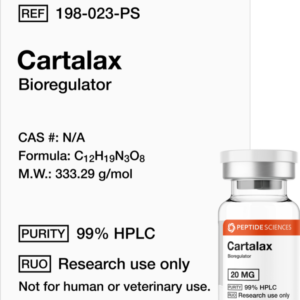
A photograph can help identify packaging and presentation, but it does not establish analytical identity, purity or suitability for an experiment. Review the written specifications and supporting documents. If the pictured packaging and delivered item differ, ask for clarification rather than drawing conclusions from appearance alone.
8. How should the product be stored?
Follow the supplied product specification and your laboratory’s validated procedures. Confirm required storage details before ordering if they are not available on the page. Do not infer a storage temperature, shelf life or solution stability period from the Cortagen name or the 20mg quantity.
9. Is this product intended for personal use?
No. The product is supplied for laboratory research and is not intended for human or veterinary use, consumption or personal administration. The catalogue does not provide personal dosing instructions. Product descriptions and research references should not be interpreted as recommendations for self-experimentation.
10. How can I compare the available research materials?
Start with the compound identity and your laboratory’s requirements. Then compare quantity, composition, packaging and documentation. Use the category pages to locate relevant items, but assess each product individually. Price and shared category placement do not establish equivalent specifications or research suitability.
11. What should I do if the documentation and label differ?
Record the discrepancy and contact the supplier with the product and batch details. Follow your laboratory’s acceptance procedures while the issue is being resolved. Keeping the order confirmation and accompanying documents together will help establish exactly which information needs clarification.
12. Can I request help with an institutional order?
Use the contact page to explain the purchasing information your institution requires. Include the exact product name and any documentation questions. Product enquiries can address catalogue and order details, while decisions about experimental suitability remain with the qualified researchers responsible for the project.
Review Cortagen 20mg Before Ordering
Select Cortagen 20mg by reviewing the named compound, stated quantity and information available for the supplied material. Confirm that the product specification meets your laboratory’s requirements and resolve essential documentation questions before completing the order.
Use the linked primary publications to investigate the research background, and keep their findings separate from claims about the identity or performance of a purchased batch. A careful review connects the literature, purchasing decision and laboratory record without assuming that one substitutes for the others.
Explore the wider catalogue when comparing related materials, or contact Peptide Lab Sciences with a specific product enquiry.
For laboratory research only. Not for human or veterinary use, consumption, injection or personal administration.
Reviews
There are no reviews yet.