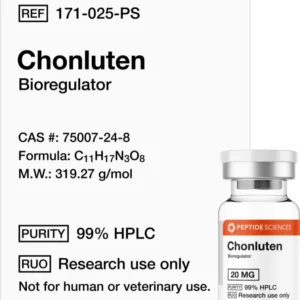
Chonluten 20mg for Laboratory Research
Chonluten 20mg is a peptide bioregulator listed in the Peptide Lab Sciences research catalogue. This product page brings together the information laboratory customers need to assess the named material, understand the scope of relevant research and prepare a documented purchasing decision.
Selecting a research compound involves matching its specification to a defined project. The product name and stated quantity provide a starting point, while the physical format, identity information and available documentation help determine whether the material meets your laboratory’s requirements.
Before ordering Chonluten 20mg, review the complete listing and resolve any missing detail that affects your decision. A familiar compound name should not replace a specification review, particularly when a project depends on a particular preparation or supporting analytical record.
This product is supplied for laboratory investigation. It is not intended for human or veterinary use, consumption or personal administration.
Understanding the Chonluten Name
Chonluten appears in scientific literature as a tripeptide investigated in cellular research. A tripeptide contains three amino-acid residues, but that description alone does not establish all the characteristics of a commercial preparation.
For Chonluten 20mg, distinguish the identity discussed in a publication from the specification of the material offered for purchase. Researchers should compare available identifiers, formulation information and supporting documents before treating two preparations as equivalent.
Names and abbreviations can help locate relevant literature, but they are not substitutes for a complete material record. If a laboratory needs a particular sequence, chemical form or other identifier, that requirement should be confirmed through the applicable specification.
Keep the full product name in your purchasing request so that colleagues can identify the intended item without interpreting an informal abbreviation.
What the 20mg Quantity Means
The Chonluten 20mg listing states a material quantity of twenty milligrams. This is a product identification detail, not a personal dose, experimental concentration or instruction for preparing a solution.
Quantity and concentration answer different questions. The amount supplied does not, by itself, establish how a laboratory should incorporate the material into a validated method. Those decisions belong to the research team and its approved procedures.
Check whether the stated amount applies to the selected item or package, and compare the basket with the purchasing request before completing an order. If the presentation is unclear, request clarification.
Do not infer the number of experiments a product will support solely from its listed mass. That assessment depends on the requirements and acceptance criteria established for the project.
Chonluten 20mg Specification Overview
Review the following information alongside the exact product specification and any documents available for the material being offered.
| Specification item | Detail to review |
|---|---|
| Product name | Chonluten 20mg |
| Catalogue description | Research peptide bioregulator |
| Stated quantity | 20mg |
| Molecular identification | Confirm through the available specification |
| Physical presentation | Confirm the supplied format |
| Additional constituents | Review any stated formulation information |
| Analytical documentation | Check availability and scope |
| Batch identification | Match records to the supplied material where available |
| Storage information | Follow the applicable product guidance |
| Intended use | Laboratory research only |
A useful specification answers the questions relevant to your work. If an essential detail is absent, identify the gap before approval rather than allowing it to become an assumption.
Retain the information used during the review so that the receiving team can compare the delivered item with the approved request.
What “Bioregulator” Means on This Page
Bioregulator is the catalogue description associated with this product. It helps organise the research material, but it does not establish a guaranteed biological effect or demonstrate suitability for a particular experiment.
Assess Chonluten 20mg through specific information: what material is supplied, how it is identified and which evidence is relevant to the intended work. A broad category label cannot answer those questions by itself.
The same principle applies when comparing other products described as bioregulators. Their shared category does not make them interchangeable. Each named material requires its own specification and literature review.
Use the category as a navigation aid, then evaluate the individual listing. This keeps the purchasing decision connected to the characteristics of the selected material rather than a general description of the product group.
Published Cellular Research Involving Chonluten
A published study evaluated Chonluten alongside several other peptide preparations in the THP-1 human monocytic cell line. The investigation concerned inflammatory and proliferative processes within that laboratory model.
This provides a specific research reference for Chonluten 20mg customers reviewing the compound’s scientific background. It does not demonstrate that a particular retail batch matches the study preparation, nor does it establish a therapeutic application.
The useful next step is to examine the original publication and identify exactly what was investigated. Review the material description, comparison groups and measurements before deciding how the work relates to your project.
A short product summary cannot replace that assessment. The relevance of a paper depends on the question your laboratory intends to answer and the differences between the study material and the proposed experimental material.
Reading the Original Publication
The original source is available through PubMed:
When evaluating this reference for Chonluten 20mg, separate the authors’ reported findings from broader interpretations that may appear in secondary descriptions. Identify which observations concern Chonluten specifically and which concern another preparation included in the paper.
Record the publication identifier and a brief explanation of its relevance in your project documentation. Note any limitations that affect the comparison with your intended work.
This reference is included for scientific context. It is not a certificate of analysis, a product endorsement or evidence that the material offered here has undergone the same testing.
Connecting Literature with a Research Question
A useful literature review starts with a defined question. Determine whether your project concerns a cellular response, material characterisation, analytical comparison or another measurable endpoint.
Before selecting Chonluten 20mg, consider which information would support or challenge the proposed interpretation. This makes it easier to decide whether a publication is directly relevant, useful only as background or unsuitable for the intended comparison.
Keep the distinction visible in your notes. For example, a paper may help identify a research model without establishing that the same result will occur in a different system.
The aim is to build a clear connection between the question, the material and the evidence. That connection is more informative than collecting references because they mention the same product name.
Avoiding Confusion Between Different Peptides
Short peptides can have similar names, overlapping research descriptions or related catalogue categories. Those similarities should not be used as evidence that they are the same material.
When reviewing Chonluten 20mg, check the complete identity information provided for the selected product. If a publication concerns a different peptide, describe it as a separate reference rather than transferring its findings to Chonluten.
This matters when preparing a comparison table or discussing potential experimental materials with colleagues. A clear identity record prevents a general topic, such as cellular regulation, from obscuring differences between compounds.
If your laboratory uses an internal material code, connect that code to the full product name and supporting specification. Maintain the same identification across procurement, inventory and project records.
Defining the Material Requirements
Write down the characteristics your project requires before comparing products. These may include identity information, a specified format, documentation availability or other acceptance conditions established by the research team.
Assess Chonluten 20mg against those written requirements. A product may be relevant to the general research topic yet lack a detail necessary for a particular study.
A simple review can distinguish confirmed information from unresolved questions. Include the source of each confirmed detail so that the purchasing decision remains traceable.
This approach also helps when several people participate in procurement. The researcher can explain what matters, the purchaser can select the correct item and the receiving team can check the delivery against the same approved record.
Comparing Chonluten 20mg with Other Listings
Compare complete specifications rather than relying on a shared name or similar photograph. Different listings may represent different quantities, formats or documentation arrangements.
For Chonluten 20mg, confirm the stated amount and review the information available for the exact item selected. If another listing uses a different quantity, consider whether any other characteristics also differ.
Price can be part of a purchasing comparison, but it does not establish identity, analytical suitability or equivalence. A lower price is only meaningful when the product meets the requirements that matter to your laboratory.
Record important differences in a short comparison table. Mark missing information clearly and resolve it before treating two offers as interchangeable for the same project.
Individual Materials and Peptide Blends
An individual material listing and a blend describe different formulation choices. A blend contains multiple identified components, while an individual listing centres on one named research material.
Chonluten 20mg should be reviewed according to its own specification. Do not assume that a combination containing a similarly named ingredient represents an equivalent purchase.
Explore the research peptides catalogue to compare individual listings, or the peptide blends category to examine separately listed combinations.
The appropriate choice follows from the experimental question. If the project needs a defined composition, confirm every relevant constituent and amount before approval. The total quantity of a blend cannot be assumed to represent the amount of each ingredient.
Chonluten 20mg Documentation Review
Documentation helps connect the catalogue description with the material under consideration. Depending on availability, this may include a product specification, analytical report, batch reference or handling information.
For Chonluten 20mg, review what each document actually establishes. Check the material name, sample identification and scope of the reported information before deciding how it supports your purchasing request.
A document for a different preparation or an earlier batch should not automatically be applied to the current item. Where the connection is unclear, ask for clarification.
Visit the quality control page to review information made available by Peptide Lab Sciences. Confirm any documentation requirement that is essential to your project before completing the order.
Understanding Analytical Claims
An analytical claim should be read alongside the evidence supporting it. A short label or percentage does not explain every aspect of a material’s identity, composition or fitness for a particular method.
When assessing Chonluten 20mg, identify the question addressed by the available report. Then consider whether that question matches the requirement established by your laboratory.
If interpretation requires specialist expertise, refer the document to an appropriately qualified colleague. Keep any clarification with the report so that later reviewers understand the basis of acceptance.
Avoid extending a limited result into a broader assurance. The most useful documentation review states what is supported, what remains uncertain and whether the available evidence is sufficient for the proposed work.
Certificates and Batch Identification
A certificate is most useful when its relationship to the supplied material is clear. Review the product description, batch or sample reference and any information necessary to connect it with the order.
For each Chonluten 20mg purchase, retain available documentation with the corresponding inventory entry. This allows the research team to retrieve the correct record when reviewing a particular container or experiment.
If a certificate does not identify the batch, ask what material it describes. Do not assume that a document retained from an earlier purchase applies to a later delivery.
The laboratory’s acceptance process should determine whether the documentation is sufficient. Keep that decision recorded alongside the information reviewed, especially when a project has specific procurement requirements.
Preparing a Clear Purchasing Request
A complete purchasing request should identify the intended product without requiring the person placing the order to interpret an informal description.
Include Chonluten 20mg, the relevant product page, the number of items required and any specification conditions established by the research team. Attach supporting correspondence if it confirms a detail necessary for approval.
The request should also identify the receiving laboratory and the person responsible for checking the delivery. If internal authorisation is required, complete it before ordering.
Keep the approved request with the order confirmation. Together, these records show what was requested, what was selected and which information supported the decision. They also provide a useful reference if a question arises when the material arrives.
Product Questions Before Ordering
Specific questions help the supplier identify the information you need. Ask about the exact missing detail rather than requesting a general assurance that a product is suitable.
When enquiring about Chonluten 20mg, include the listing and describe the specification or document required. Questions may concern the supplied format, identity information or availability of a report relevant to the offered material.
Use the contact page for product, documentation and order enquiries. Save the response with the purchasing record so that other team members can review it.
Resolve essential questions before checkout. If information remains unavailable, the laboratory should assess that limitation explicitly instead of assuming that the requirement has been met.
Checking the Basket and Delivery Details
Before submitting an order, compare the basket with the approved purchasing request. Confirm the product name, quantity, number of items and delivery address.
For Chonluten 20mg, review the delivery options displayed for the selected destination. Use the information provided during ordering to plan receipt rather than assuming that an earlier delivery arrangement will apply again.
Let the receiving team know what is expected and who will check it. Retain the order reference where the relevant staff can retrieve it if a delivery question arises.
If a project depends on receiving material within a particular period, clarify the available arrangements before purchasing. A clear handover helps connect the delivery with the right laboratory, documents and responsible personnel.
Receiving Chonluten 20mg
On arrival, compare the delivered item with the order confirmation and approved specification. Check the product identification, stated quantity and available batch information.
Enter Chonluten 20mg into inventory using a consistent description that distinguishes it from other materials. Connect the entry with supporting documents and the relevant purchasing record.
If the label or accompanying information differs from the approved request, record the discrepancy and contact the supplier. Follow the laboratory’s receiving procedure while the issue is reviewed.
Do not resolve an important difference through an assumption based on appearance. Clear receipt records make it easier to determine which material was accepted and which information was available at that point.
Storage and Handling Information
Follow the information applicable to the supplied material together with your laboratory’s approved procedures. Do not substitute instructions from another product for the guidance relevant to the item received.
Before handling Chonluten 20mg, confirm that the responsible personnel can access the specification and any available safety information. Refer missing or unclear instructions to the appropriate laboratory reviewer.
Maintain the connection between the container and its inventory record during internal transfers. If your procedures require handling events to be recorded, use the same material identifier consistently.
This description does not assign a universal storage temperature, preparation method or shelf life. Those details require appropriate product-specific support and an assessment of the intended laboratory work.
Recording the Material in a Research Project
Consistent material records help colleagues understand what was used without relying on memory or a product name alone. Establish the naming convention before the material enters a project.
Where Chonluten 20mg appears in an experimental record, connect it with the laboratory’s inventory identifier and relevant batch information. Keep the supporting specification accessible alongside the project documentation.
Record changes in source or supplied characteristics when they occur. If the team judges that a difference does not affect the work, document the reasoning rather than leaving the decision implicit.
A clear record supports later review and makes it easier to trace the relationship between a purchase, a stored item and a particular set of observations.
Interpreting Findings Responsibly
A research observation should be described within the scope of the method that produced it. A result from one system does not automatically establish the same response in another setting.
When considering Chonluten 20mg, keep three questions separate: what the publication reports, what the product documentation establishes and what your project requires. Each needs its own assessment.
Avoid turning a general research description into a promise about a particular experimental outcome. The purpose of the material review is to identify a suitable candidate for investigation, not to predetermine the result.
Record uncertainties alongside the evidence. This allows the team to interpret findings with a clear understanding of the material and the limitations present when the project began.
Frequently Asked Questions
1. What Is Chonluten 20mg?
Chonluten 20mg is a research product listed as a peptide bioregulator. The stated quantity is twenty milligrams. Review the individual specification and available documentation before determining whether the material meets your laboratory’s requirements for a particular project.
2. What Does Tripeptide Mean?
A tripeptide contains three amino-acid residues. The term describes a structural feature rather than the complete specification of a commercial product. Researchers still need to confirm the identity, presentation and other characteristics relevant to the material they intend to purchase.
3. Is 20mg a Dosing Instruction?
No. It identifies the stated product quantity. It is not a personal dose, a preparation instruction or an experimental concentration. Laboratory methods should follow the requirements established by qualified personnel and the applicable approved procedures.
4. What Research Has Included Chonluten?
The publication linked above includes Chonluten in a cellular investigation. Read the original paper to understand its material, methods and limitations. Its inclusion here provides research context and does not verify a particular commercial batch or demonstrate a personal treatment application.
5. Does Chonluten 20mg Include a Certificate?
Confirm what documentation is available for the material being offered. If your laboratory requires a certificate, review its scope and relationship to the supplied item before purchase. Do not assume that a report exists or applies without checking the relevant details.
6. Can a Scientific Paper Verify This Product?
A paper describes the preparation and methods used by its authors. It does not independently verify a separate supplier’s item. Evaluate the commercial material through its specification, supporting documents and your laboratory’s own acceptance process.
7. How Should I Compare Different Quantities?
Compare the complete specifications as well as the stated amounts. Check whether format, documentation or other relevant characteristics differ. A larger quantity is not automatically a better choice; suitability depends on the requirements and practical needs of the project.
8. Is Chonluten 20mg Intended for Human Use?
No. This listing is for laboratory research material. It is not intended for human or veterinary use, consumption or personal administration. The page does not provide instructions for dosing, injection or self-experimentation.
9. Can I Substitute Another Bioregulator?
A shared category does not establish that two materials are interchangeable. Compare their identities and specifications with the experimental requirements. Any proposed substitution should be assessed by the research team rather than inferred from a similar catalogue description.
10. What Should I Ask Before Ordering?
Ask about any missing detail essential to the purchasing decision. This may include identity information, supplied format or documentation availability. Include the exact listing in your enquiry and keep the response with the approved purchasing record.
11. How Should Chonluten 20mg Be Stored?
Follow the guidance applicable to the supplied product and your laboratory’s procedures. If the necessary information is unclear or unavailable, request clarification. Do not automatically apply storage instructions taken from another preparation or a different supplier’s listing.
12. What Should I Check on Receipt?
Compare the product name, quantity and available batch details with the approved order. Retain the accompanying information and record discrepancies. Follow the laboratory’s receiving process before accepting the material for its intended research use.
13. Does a Previous Report Cover a New Order?
Not necessarily. A previous report may concern a different batch or preparation. Review the information associated with the new purchase and establish its relevance. Keep each document connected to the material it actually describes.
14. Can I Request More Product Information?
Contact Peptide Lab Sciences through the website contact page with a specific question. Include the full product name and explain which information is needed. Resolve essential specification requirements before placing the order.
15. How Do I Decide Whether the Material Is Suitable?
Compare the confirmed specification with the needs established by your research team. Review relevant literature, identify unresolved questions and assess available documentation. Suitability follows from that review rather than a familiar product name or broad category label.
Review Chonluten 20mg Before Purchasing
Review Chonluten 20mg with a clear objective: identify the material, understand the available evidence and determine whether the specification meets your laboratory’s needs.
Check the stated quantity, confirm essential product details and retain the documentation supporting your decision. Use the research reference for scientific context while assessing the supplied item separately through its own records.
If a necessary detail remains unresolved, contact Peptide Lab Sciences before ordering. Compare the final basket with the approved request and arrange for the receiving team to check the delivery against that record.
For laboratory research only. Not for human or veterinary use. Not for consumption or personal administration.
Reviews
There are no reviews yet.